


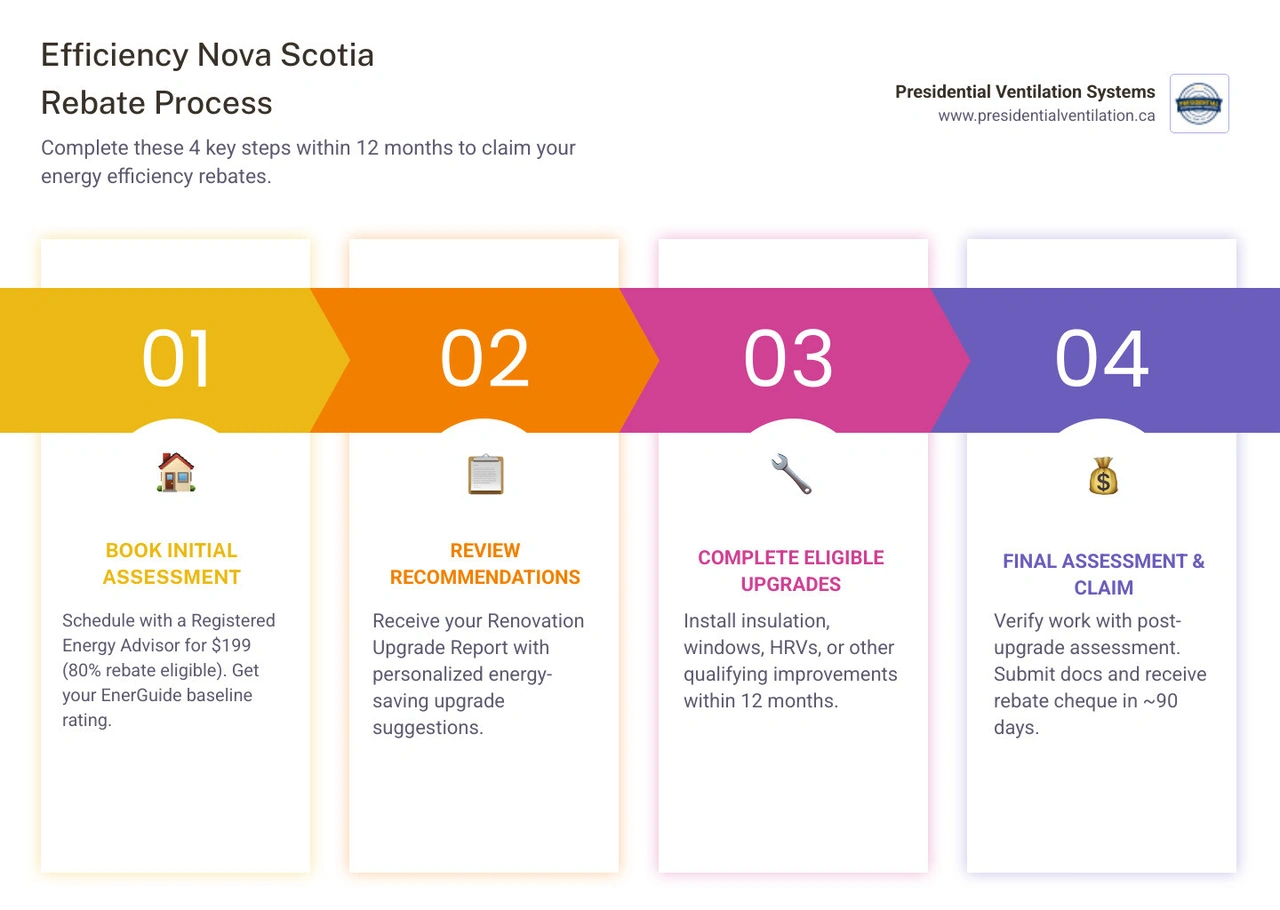
The efficiency nova scotia rebate process explained in plain terms: Nova Scotia homeowners can access hundreds to thousands of dollars in rebates by completing a Home Energy Assessment, making eligible upgrades, and submitting the required documentation — all within a 12-month window.
Here is a quick overview of how the process works:
1. Book a Home Energy Assessment with a Registered Energy Advisor
2. Review your upgrade recommendations from your EnerGuide Renovation Upgrade Report
3. Complete eligible upgrades (insulation, heat recovery ventilators, windows, and more) within 12 months
4. Book your final assessment to verify the completed work
5. Receive your rebate cheque — typically mailed within 90 days of your final assessment
If you own a home in Nova Scotia, you have probably heard that energy efficiency rebates exist — but actually getting the money can feel like a maze. There are multiple programs, income thresholds, documentation requirements, and deadlines to track. One missed step can mean a delayed or denied rebate.
A quick scroll through community forums shows that many Nova Scotians feel the same frustration. Homeowners who have gone through programs like the Home Energy Assessment describe confusion over which upgrades qualify, what paperwork their contractor needs to provide, and how long the whole process actually takes.
The good news is that the process is very manageable once you understand how it flows from start to finish. Nova Scotia homeowners can qualify for up to $5,000 in rebates through the standard Home Energy Assessment program — and moderate-income households may be eligible for significantly more when additional programs are combined.
This guide walks you through every step so you can claim what you are owed without the headache.
Efficiency Nova Scotia is Canada’s first energy efficiency utility. They are a non-profit organization dedicated to helping Nova Scotians reduce their energy consumption and save money. Whether you live in a bustling neighborhood in Halifax or a quiet corner of Mount Uniacke, their programs are designed to make high-performance home upgrades more affordable.
To participate in the most popular rebate streams, you generally need to meet a few basic criteria:
• The property must be your primary residence.
• You must provide proof of ownership, such as a property tax bill.
• The home must be in a livable condition (not a shell or under major initial construction).
• The dwelling must be an eligible type, which includes detached houses, semi-detached homes, row houses, and even some mobile homes on permanent foundations.
One of the most important aspects of the efficiency nova scotia rebate process explained involves income levels. While the standard Home Energy Assessment (HEA) program is open to everyone, there are enhanced incentives for moderate-income households. The Moderate Income Rebate (MIR) program can provide up to $10,000 in additional rebates on top of the standard $5,000, potentially totaling $15,000 for qualifying upgrades.
Eligibility for the "Moderate Income" stream depends on the number of people living in your home and your combined household after-tax income. As of April 2026, the thresholds generally align with the following:
• 1 Person — Moderate Income After-Tax Threshold: ~$37,260
• 2 People — Moderate Income After-Tax Threshold: ~$46,390
• 3 People — Moderate Income After-Tax Threshold: ~$57,000
• 4 People — Moderate Income After-Tax Threshold: ~$69,200
• 5+ People — Moderate Income After-Tax Threshold: Up to ~$126,500
If you fall within these brackets, you may qualify for a free assessment and higher rebate percentages. For everyone else, the standard Efficiency Nova Scotia rebate process explained still offers significant financial relief for making your home more comfortable.
Understanding the timeline is crucial. You cannot simply buy a bunch of insulation, install it, and then ask for money. The program is built around "before and after" snapshots of your home’s energy performance.
The journey begins with a Home Energy Assessment. This is conducted by a Registered Energy Advisor (REA) who is certified to use the EnerGuide Rating System. This advisor is your guide through the process. They will inspect your attic, basement, walls, and mechanical systems to see where energy is escaping.
Once the initial assessment is done, you receive a Renovation Upgrade Report. This is essentially a "to-do list" for your home. It ranks upgrades based on what will save you the most energy. From the date of this first assessment, you have a strict 12-month completion window to finish your chosen upgrades and have your final assessment performed.
The first step is booking that initial evaluation. In Nova Scotia, the standard fee for this service is $199. While that might seem like an extra cost, it is important to know that Efficiency Nova Scotia actually covers more than 80% of the true cost of these evaluations to keep them affordable for homeowners.
During the assessment, the advisor will:
• Perform a blower door test to find air leaks.
• Check insulation levels in the attic, walls, and foundation.
• Inspect windows, doors, and your ventilation systems.
• Establish a baseline "EnerGuide Rating" for your home.
This baseline is the "before" picture. Without it, you cannot prove how much you improved your home, which is why you must book this before you start any work. If you live in Bedford or Fall River and are looking to start, the Efficiency Nova Scotia rebate process explained begins with this simple phone call or online booking.
After you have completed the upgrades recommended in your report—such as adding attic insulation or upgrading to high-performance windows—it is time for the "after" picture. You must book a follow-up assessment with your Energy Advisor.
During this final visit, the advisor verifies that the materials were installed correctly and meet the program's technical requirements (like R-values for insulation). They will then submit the final paperwork to Efficiency Nova Scotia on your behalf.
Once the final assessment is filed, the clock starts on your payment. The standard 90-day processing timeline applies to most provincial rebate cheques. If you are in Waverley or Timberlea and have finished your retrofits, ensure you have all your receipts ready for this final visit. The Efficiency Nova Scotia rebate process explained ensures that as long as the work is verified, your cheque will be in the mail within three months.
While many people focus on mechanical systems, some of the most effective rebates are found in the "envelope" of your home—the walls, roof, and floors that keep the weather out. We often see homeowners in areas like Sackville or Cole Harbour overlook these, but they are the foundation of energy efficiency.
Heat rises, and in many older Nova Scotia homes, it goes straight through the roof. Rebates for attic insulation are calculated based on the area you insulate and the final R-value achieved. For example, moving from a low R-value to R-50 or higher can net you significant savings. This includes flat roofs and cathedral ceilings, though the rebate amounts may vary.
Insulating your exterior walls can be a bigger job, but the rebates reflect that, offering up to $5,000 in some cases. Foundation insulation is equally important. Whether you are insulating basement walls or crawlspaces, ensuring you meet the minimum R-value requirements (often R-10 to R-22 depending on the area) is key to qualifying.
It is not just about the thickness of the insulation; it is about stopping the drafts. Air sealing rebates (often around $200) are available when you meet specific targets for reducing air changes per hour. Additionally, if you install a Heat Recovery Ventilator (HRV) to ensure fresh air circulates in your now-sealed home, you can access further rebates, provided the unit is HVI certified.
Upgrading to ENERGY STAR certified windows and doors is a popular choice. In the efficiency nova scotia rebate process explained, these are often paid out per "rough opening." This means if you replace a large bay window that fits into one structural opening, it counts as one unit for the rebate.
By combining these building envelope upgrades, you can hit the $5,000 maximum for the HEA program. If you qualify for the Moderate Income Rebate, those same upgrades could be worth even more, helping you achieve a total rebate of up to $15,000. For more localized info on starting these upgrades, check out the Efficiency Nova Scotia rebate process explained for your specific community.
The number one reason rebates get delayed is missing or incorrect paperwork. Efficiency Nova Scotia is a diligent organization, and they require specific proof that the work was done to code and by the right people.
Your contractor's invoice needs to be more than just a total price. To pass the audit, it should include:
• The contractor’s business name, address, and contact info.
• The homeowner’s name and the address where the work was performed.
• A detailed description of the work (e.g., "Installed 500 sq. ft. of R-50 blown-in cellulose insulation").
• The specific model numbers for any mechanical equipment.
• The date the work was completed.
• Proof of payment (showing a zero balance or "Paid in Full").
1. Starting Too Early: If you install your windows or insulation before your initial assessment, you cannot get a rebate for them. There are no exceptions for "retroactive" rebates in the HEA program.
2. Missing the Deadline: You have exactly 12 months from the date of your first assessment. If you finish the work in month 13, you may lose your eligibility unless an extension was granted by your advisor.
3. Ineligible Upgrades: Not all products qualify. For example, insulation in a new addition to the home is usually not eligible because the program focuses on retrofitting existing heated spaces.
4. DIY Insulation: While some programs allow for homeowner-installed insulation, you must take clear photos of the work in progress to prove the R-value and coverage to your advisor.
We recommend keeping all records—including receipts, invoices, and any permits—for at least five years. This protects you in case of any future audits or questions regarding your home’s energy profile.
For provincial rebates through Efficiency Nova Scotia, you can typically expect your cheque to arrive in the mail within 90 days of your final assessment. It is important to ensure your mailing address is correct with your Energy Advisor to avoid any delays.
Yes! If you meet the moderate-income criteria based on your household size and after-tax income, the $199 fee for the Home Energy Assessment is typically waived. This makes it even easier for families in areas like Eastern Passage or Spryfield to start their energy-saving journey.
Generally, no. For the Home Energy Assessment program, you must have the "before" assessment completed before any of the rebate-eligible work begins. If you have already finished an upgrade, you might still qualify for certain "instant" rebates or specific heating system rebates if the purchase was within the last 180 days, but you will miss out on the larger, comprehensive HEA and MIR packages.
Navigating the efficiency nova scotia rebate process explained in this guide doesn't have to be a headache. By following the steps—starting with a professional assessment and ending with a verified final inspection—you can significantly offset the cost of making your home more comfortable and energy-efficient.
At Presidential Ventilation Systems Ltd., we have spent over 30 years helping homeowners across the Halifax Regional Municipality, from Bedford to Porters Lake, improve their homes' performance. Whether you need professional insulation services to seal up your attic or electrical upgrades to support new systems, we understand the local climate and the specific requirements of Nova Scotia's rebate programs.
The savings are there for the taking, and the environmental benefits of a more efficient home are a win for everyone. Don't let the paperwork stand in your way of a warmer, more affordable home this year.
Start your energy efficiency journey today and let us help you turn those energy-saving recommendations into a reality.

The efficiency nova scotia rebate process explained in plain terms: Nova Scotia homeowners can access hundreds to thousands of dollars in rebates by completing a Home Energy Assessment, making eligible upgrades, and submitting the required documentation — all within a 12-month window.
Here is a quick overview of how the process works:
1. Book a Home Energy Assessment with a Registered Energy Advisor
2. Review your upgrade recommendations from your EnerGuide Renovation Upgrade Report
3. Complete eligible upgrades (insulation, heat recovery ventilators, windows, and more) within 12 months
4. Book your final assessment to verify the completed work
5. Receive your rebate cheque — typically mailed within 90 days of your final assessment
If you own a home in Nova Scotia, you have probably heard that energy efficiency rebates exist — but actually getting the money can feel like a maze. There are multiple programs, income thresholds, documentation requirements, and deadlines to track. One missed step can mean a delayed or denied rebate.
A quick scroll through community forums shows that many Nova Scotians feel the same frustration. Homeowners who have gone through programs like the Home Energy Assessment describe confusion over which upgrades qualify, what paperwork their contractor needs to provide, and how long the whole process actually takes.
The good news is that the process is very manageable once you understand how it flows from start to finish. Nova Scotia homeowners can qualify for up to $5,000 in rebates through the standard Home Energy Assessment program — and moderate-income households may be eligible for significantly more when additional programs are combined.
This guide walks you through every step so you can claim what you are owed without the headache.
Efficiency Nova Scotia is Canada’s first energy efficiency utility. They are a non-profit organization dedicated to helping Nova Scotians reduce their energy consumption and save money. Whether you live in a bustling neighborhood in Halifax or a quiet corner of Mount Uniacke, their programs are designed to make high-performance home upgrades more affordable.
To participate in the most popular rebate streams, you generally need to meet a few basic criteria:
• The property must be your primary residence.
• You must provide proof of ownership, such as a property tax bill.
• The home must be in a livable condition (not a shell or under major initial construction).
• The dwelling must be an eligible type, which includes detached houses, semi-detached homes, row houses, and even some mobile homes on permanent foundations.
One of the most important aspects of the efficiency nova scotia rebate process explained involves income levels. While the standard Home Energy Assessment (HEA) program is open to everyone, there are enhanced incentives for moderate-income households. The Moderate Income Rebate (MIR) program can provide up to $10,000 in additional rebates on top of the standard $5,000, potentially totaling $15,000 for qualifying upgrades.
Eligibility for the "Moderate Income" stream depends on the number of people living in your home and your combined household after-tax income. As of April 2026, the thresholds generally align with the following:
• 1 Person — Moderate Income After-Tax Threshold: ~$37,260
• 2 People — Moderate Income After-Tax Threshold: ~$46,390
• 3 People — Moderate Income After-Tax Threshold: ~$57,000
• 4 People — Moderate Income After-Tax Threshold: ~$69,200
• 5+ People — Moderate Income After-Tax Threshold: Up to ~$126,500
If you fall within these brackets, you may qualify for a free assessment and higher rebate percentages. For everyone else, the standard Efficiency Nova Scotia rebate process explained still offers significant financial relief for making your home more comfortable.
Understanding the timeline is crucial. You cannot simply buy a bunch of insulation, install it, and then ask for money. The program is built around "before and after" snapshots of your home’s energy performance.
The journey begins with a Home Energy Assessment. This is conducted by a Registered Energy Advisor (REA) who is certified to use the EnerGuide Rating System. This advisor is your guide through the process. They will inspect your attic, basement, walls, and mechanical systems to see where energy is escaping.
Once the initial assessment is done, you receive a Renovation Upgrade Report. This is essentially a "to-do list" for your home. It ranks upgrades based on what will save you the most energy. From the date of this first assessment, you have a strict 12-month completion window to finish your chosen upgrades and have your final assessment performed.
The first step is booking that initial evaluation. In Nova Scotia, the standard fee for this service is $199. While that might seem like an extra cost, it is important to know that Efficiency Nova Scotia actually covers more than 80% of the true cost of these evaluations to keep them affordable for homeowners.
During the assessment, the advisor will:
• Perform a blower door test to find air leaks.
• Check insulation levels in the attic, walls, and foundation.
• Inspect windows, doors, and your ventilation systems.
• Establish a baseline "EnerGuide Rating" for your home.
This baseline is the "before" picture. Without it, you cannot prove how much you improved your home, which is why you must book this before you start any work. If you live in Bedford or Fall River and are looking to start, the Efficiency Nova Scotia rebate process explained begins with this simple phone call or online booking.
After you have completed the upgrades recommended in your report—such as adding attic insulation or upgrading to high-performance windows—it is time for the "after" picture. You must book a follow-up assessment with your Energy Advisor.
During this final visit, the advisor verifies that the materials were installed correctly and meet the program's technical requirements (like R-values for insulation). They will then submit the final paperwork to Efficiency Nova Scotia on your behalf.
Once the final assessment is filed, the clock starts on your payment. The standard 90-day processing timeline applies to most provincial rebate cheques. If you are in Waverley or Timberlea and have finished your retrofits, ensure you have all your receipts ready for this final visit. The Efficiency Nova Scotia rebate process explained ensures that as long as the work is verified, your cheque will be in the mail within three months.
While many people focus on mechanical systems, some of the most effective rebates are found in the "envelope" of your home—the walls, roof, and floors that keep the weather out. We often see homeowners in areas like Sackville or Cole Harbour overlook these, but they are the foundation of energy efficiency.
Heat rises, and in many older Nova Scotia homes, it goes straight through the roof. Rebates for attic insulation are calculated based on the area you insulate and the final R-value achieved. For example, moving from a low R-value to R-50 or higher can net you significant savings. This includes flat roofs and cathedral ceilings, though the rebate amounts may vary.
Insulating your exterior walls can be a bigger job, but the rebates reflect that, offering up to $5,000 in some cases. Foundation insulation is equally important. Whether you are insulating basement walls or crawlspaces, ensuring you meet the minimum R-value requirements (often R-10 to R-22 depending on the area) is key to qualifying.
It is not just about the thickness of the insulation; it is about stopping the drafts. Air sealing rebates (often around $200) are available when you meet specific targets for reducing air changes per hour. Additionally, if you install a Heat Recovery Ventilator (HRV) to ensure fresh air circulates in your now-sealed home, you can access further rebates, provided the unit is HVI certified.
Upgrading to ENERGY STAR certified windows and doors is a popular choice. In the efficiency nova scotia rebate process explained, these are often paid out per "rough opening." This means if you replace a large bay window that fits into one structural opening, it counts as one unit for the rebate.
By combining these building envelope upgrades, you can hit the $5,000 maximum for the HEA program. If you qualify for the Moderate Income Rebate, those same upgrades could be worth even more, helping you achieve a total rebate of up to $15,000. For more localized info on starting these upgrades, check out the Efficiency Nova Scotia rebate process explained for your specific community.
The number one reason rebates get delayed is missing or incorrect paperwork. Efficiency Nova Scotia is a diligent organization, and they require specific proof that the work was done to code and by the right people.
Your contractor's invoice needs to be more than just a total price. To pass the audit, it should include:
• The contractor’s business name, address, and contact info.
• The homeowner’s name and the address where the work was performed.
• A detailed description of the work (e.g., "Installed 500 sq. ft. of R-50 blown-in cellulose insulation").
• The specific model numbers for any mechanical equipment.
• The date the work was completed.
• Proof of payment (showing a zero balance or "Paid in Full").
1. Starting Too Early: If you install your windows or insulation before your initial assessment, you cannot get a rebate for them. There are no exceptions for "retroactive" rebates in the HEA program.
2. Missing the Deadline: You have exactly 12 months from the date of your first assessment. If you finish the work in month 13, you may lose your eligibility unless an extension was granted by your advisor.
3. Ineligible Upgrades: Not all products qualify. For example, insulation in a new addition to the home is usually not eligible because the program focuses on retrofitting existing heated spaces.
4. DIY Insulation: While some programs allow for homeowner-installed insulation, you must take clear photos of the work in progress to prove the R-value and coverage to your advisor.
We recommend keeping all records—including receipts, invoices, and any permits—for at least five years. This protects you in case of any future audits or questions regarding your home’s energy profile.
For provincial rebates through Efficiency Nova Scotia, you can typically expect your cheque to arrive in the mail within 90 days of your final assessment. It is important to ensure your mailing address is correct with your Energy Advisor to avoid any delays.
Yes! If you meet the moderate-income criteria based on your household size and after-tax income, the $199 fee for the Home Energy Assessment is typically waived. This makes it even easier for families in areas like Eastern Passage or Spryfield to start their energy-saving journey.
Generally, no. For the Home Energy Assessment program, you must have the "before" assessment completed before any of the rebate-eligible work begins. If you have already finished an upgrade, you might still qualify for certain "instant" rebates or specific heating system rebates if the purchase was within the last 180 days, but you will miss out on the larger, comprehensive HEA and MIR packages.
Navigating the efficiency nova scotia rebate process explained in this guide doesn't have to be a headache. By following the steps—starting with a professional assessment and ending with a verified final inspection—you can significantly offset the cost of making your home more comfortable and energy-efficient.
At Presidential Ventilation Systems Ltd., we have spent over 30 years helping homeowners across the Halifax Regional Municipality, from Bedford to Porters Lake, improve their homes' performance. Whether you need professional insulation services to seal up your attic or electrical upgrades to support new systems, we understand the local climate and the specific requirements of Nova Scotia's rebate programs.
The savings are there for the taking, and the environmental benefits of a more efficient home are a win for everyone. Don't let the paperwork stand in your way of a warmer, more affordable home this year.
Start your energy efficiency journey today and let us help you turn those energy-saving recommendations into a reality.

You upgrade your home's insulation, seal the drafty doors, and turn on your highly efficient heating system, only to face a frustrating new problem: waking up to windows dripping with water. Finding reliable home maintenance tips and troubleshooting strategies for indoor air quality is a major priority during the colder months. Modern energy-efficient homes are tightly sealed to prevent valuable heat from escaping. However, this airtight construction inadvertently traps stale air and moisture indoors. The result is excessive indoor humidity levels causing window condensation, which can eventually lead to mold growth and poor air quality.
Many homeowners assume their new heating equipment will automatically handle air circulation and moisture control. The reality is that true home comfort requires a careful balance between advanced heating technology and dedicated mechanical ventilation.
If you are exploring solutions for trapped moisture and stale air, learning how Heat Pumps and modern Ductless Heat Pumps fit into your home's ecosystem is a great place to start.
The building science behind indoor humidity is relatively straightforward, but cold weather drastically amplifies the effects. A standard family of four generates roughly 1.5 to 2 gallons of moisture every single day. This moisture comes from routine, unavoidable activities like breathing, cooking, showering, and doing laundry. Without proper exhaust mechanisms built into the home, this water vapor has nowhere to go. It remains suspended in your indoor air.
During a typical Nova Scotia winter, our team at Presidential Ventilation Systems regularly sees deep freezes and coastal dampness create the perfect storm for condensation. When the warm, humid air inside your home makes contact with cold window glass, the air rapidly cools. Cold air cannot hold as much moisture as warm air, so it releases the excess water directly onto the cold surface as liquid condensation. Over time, this constant dampness degrades your window frames, damages drywall, and creates an ideal breeding ground for airborne mold spores.
To understand why this happens, you have to look at your home's thermal envelope. The thermal envelope is the physical barrier between the conditioned air inside your home and the unconditioned air outside. This includes your roof, foundation, windows, doors, and wall insulation. In older, drafty homes, the thermal envelope is weak. Heat escapes easily, but so does indoor moisture, as fresh outdoor air constantly leaks in through the cracks.
When you upgrade your insulation and seal air leaks to improve energy efficiency, you tighten that envelope. This is fantastic for lowering your heating bills, but it completely disrupts the home's natural air exchange. You have successfully trapped the heat, but you have also trapped the humidity.
• Breathing and Perspiration — Moisture Generated (Daily Estimate): 0.5 to 1 Gallon — Impact on Tightly Sealed Homes: Constant baseline humidity that builds up overnight, especially in bedrooms.
• Cooking and Boiling Water — Moisture Generated (Daily Estimate): 2 to 4 Pints — Impact on Tightly Sealed Homes: Rapid spikes in airborne moisture that quickly settle on kitchen windows.
• Showering and Bathing — Moisture Generated (Daily Estimate): 0.5 Gallons — Impact on Tightly Sealed Homes: Heavy, localized humidity that spreads to adjoining rooms without exhaust fans.
• Washing and Drying Laundry — Moisture Generated (Daily Estimate): 1 to 2 Pints — Impact on Tightly Sealed Homes: Steady moisture release, particularly if dryers are not perfectly vented outdoors.
Targeted, efficient heating: Ductless systems provide highly efficient, targeted heating without the need for traditional ductwork. They use a closed refrigerant loop to absorb ambient heat from the outdoor air and transfer it directly into your living spaces. Because they do not rely on a centralized network of leaky metal ducts, they deliver heat exactly where you need it with minimal energy loss.
Continuous air circulation: While these systems continuously circulate and filter the indoor air, it is critical to understand what they do not do. Ductless heat pumps do not pull fresh outside air into the home. They simply pull the existing room air across a heated coil, filter out dust and particulates, and push that same air back into the room.
The common misconception: A widespread misconception we often encounter is that upgrading to a premium heating system will automatically solve stale air issues. If your home already suffers from excessive indoor humidity levels causing window condensation, a ductless unit will not remove that moisture on its own during the heating season. For comprehensive comfort, you need to pair reliable equipment, like Lennox Ductless Systems, with a dedicated strategy for fresh air exchange.
Optimizing your HVAC system and managing indoor humidity requires a proactive approach. Based on our experience servicing homes throughout Mount Uniacke and the surrounding areas, following these actionable home maintenance tips and troubleshooting steps will help you maintain a healthier indoor environment and protect your equipment.
1. Check and clean indoor air filters regularly: Your ductless unit relies on unrestricted airflow to function efficiently. Dust and debris clog the indoor filters, forcing the fan motor to work harder and reducing the volume of air circulating through the room. Clean your reusable filters every few weeks to ensure optimal performance.
2. Monitor and stabilize thermostat settings: Maintain a consistent temperature rather than drastically turning the heat down when you leave the house. Large temperature fluctuations encourage condensation. When the indoor air cools too quickly, it loses its ability to hold moisture, dumping water onto your windows and walls.
3. Keep outdoor units clear of snow and debris: During a harsh Nova Scotia winter, snowdrifts and ice buildup can choke your outdoor compressor. The system needs clear airflow on all sides to extract heat efficiently. Gently brush away snow and ensure gutters aren't dripping freezing water directly onto the unit.
4. Utilize point-source exhaust fans: Always run bathroom exhaust fans for at least 30 minutes after showering, and use your kitchen range hood when boiling water. This removes heavy moisture at the source before it can migrate through the rest of the house.
One of the best practices for ductless systems is to "set it and forget it." Running the system continuously at a comfortable temperature is far more efficient than turning it on and off. Proper, continuous operation ensures even heating and limits the creation of cold spots in the corners of rooms where moisture tends to accumulate and form mold.
Routine professional care is just as important as your daily habits. For instance, we recently visited a homeowner in Mount Uniacke who scheduled an inspection and deep clean last fall. Our technician performed a thorough inspection, cleaned the internal components, and tested the system, providing valuable information on keeping the unit running efficiently through the colder months. Staying on top of this through a preventive maintenance plan ensures your system is always ready for the next temperature drop.
Defining mechanical ventilation: If your home is tightly sealed, the most effective way to eliminate stale air is through mechanical ventilation. A Heat Recovery Ventilator (HRV) is a system designed specifically to exchange stale indoor air with fresh outdoor air in a controlled manner.
The heat recovery process: What makes an HRV system brilliant is its ability to save energy. Inside the unit is a specialized heat exchange core. As the warm, stale, humid air is exhausted out of your home, it passes through this core. At the same time, cold, fresh outdoor air is pulled into the home through a separate channel in the same core. The heat from the outgoing air is transferred to the incoming air. The two airstreams never actually mix, but the heat is recovered, pre-warming the fresh air before it enters your living space.
Lowering indoor humidity: This continuous air exchange dramatically lowers indoor humidity. By constantly flushing out the moisture-laden air and replacing it with drier outdoor air, an HRV effectively eliminates excessive indoor humidity levels causing window condensation, all without sacrificing the heating efficiency you worked so hard to achieve.
You might wonder why you shouldn't just crack a window to let fresh air in. Opening a window during freezing temperatures completely defeats the purpose of your insulation and forces your heating system to work overtime to compensate for the massive heat loss. An HRV recovers up to 80% of the heat that would otherwise be lost, providing incredible energy savings. Furthermore, the health benefits of continuously flushing out indoor pollutants, cooking odors, volatile organic compounds (VOCs), and excess moisture are immeasurable.

Upgrading your home's heating system without addressing the ventilation is a common oversight. When older homes are retrofitted with modern, airtight insulation and new windows, the natural drafts disappear. If you install a high-efficiency heating system into this newly sealed environment without adding mechanical ventilation, you will almost certainly face air quality issues.
HRVs complement ductless configurations perfectly. Because ductless units do not use central ductwork, an HRV can be installed with its own small, dedicated ducting system to pull stale air from bathrooms and kitchens, while delivering fresh air to bedrooms and living areas. The key to success is proper system sizing. The ventilation rate must match your home's exact square footage and occupancy levels to ensure the air is exchanged frequently enough to prevent condensation.
Professional design is critical to ensure airflow pathways effectively reach all living areas without creating uncomfortable drafts. As a Daikin Comfort Pro dealer, our team at Presidential Ventilation Systems understands the importance of certified, expertly designed installations that guarantee robust performance and protect your warranty coverage. A well-designed ecosystem ensures you get the most out of the best ductless heat pumps on the market while maintaining pristine indoor air quality, no matter how harsh the Nova Scotia winter gets.
Identifying warning signs: While routine filter cleaning is a great DIY task, certain symptoms require expert attention. If you notice persistent mold growth around your windows, unresponsive heating units, strange grinding noises, or heavy ice buildup on the outdoor compressor that cannot be safely brushed away, it is time to call a professional.
Safety limits and licensing: Never attempt DIY electrical repairs or try to modify refrigerant lines. These systems operate under high pressure and high voltage, requiring specialized licensing and training to service safely. Tinkering with internal components can easily void your warranty or cause critical system failures.
We had a customer reach out to us last fall when their mini splits were not working properly. A previous company had failed to identify or fix the problem. Our professional technicians diagnosed the issue, confirmed the necessary repairs were covered under warranty, and fixed the system swiftly, restoring full functionality.
Professional assessments: A licensed expert can do more than just fix broken parts. They can perform a comprehensive assessment of your home's airflow and humidity levels to determine exactly why you are experiencing excessive indoor humidity levels causing window condensation. Furthermore, professional assessments can determine if your home qualifies for generic energy rebates or incentive programs when upgrading to high-efficiency ventilation or heating systems, helping offset the cost of improving your home's comfort.
Your windows sweat because warm, humid indoor air is coming into contact with the freezing cold glass. As the air cools against the window, it loses its capacity to hold moisture, leaving liquid condensation behind. In tightly sealed homes during a Nova Scotia winter, this trapped humidity has no way to escape without mechanical ventilation.
Yes, in most tightly sealed homes, an HRV is highly recommended alongside a ductless system. Ductless heat pumps are excellent at heating and circulating existing indoor air, but they do not bring in fresh outdoor air. An HRV provides the necessary fresh air exchange to remove stale air and excess moisture.
Start by checking your daily habits: ensure you are using bathroom and kitchen exhaust fans consistently. Next, check your home's thermal envelope to see if you recently sealed drafts without adding ventilation. If the humidity persists, you likely need a mechanical solution like an HRV to actively exhaust the moisture-heavy air.
An HRV system requires regular filter cleaning or replacement every few months to maintain proper airflow. The heat exchange core should also be removed and gently washed annually according to the manufacturer's instructions. Finally, ensure the exterior intake and exhaust hoods remain clear of snow, leaves, and debris.
The most effective fix for poor ventilation in an airtight home is installing a Heat Recovery Ventilator. This system mechanically forces stale air out and pulls fresh air in, while recovering the heat to maintain energy efficiency. It acts as the lungs of your home, ensuring healthy air quality without relying on drafts.
True winter comfort relies on much more than just a powerful heating system; it demands a delicate balance between efficient temperature control and effective moisture management. When you seal your home against the cold, you must also provide a pathway for stale, humid air to escape. By understanding the mechanics of your thermal envelope and the benefits of mechanical ventilation, you can permanently resolve excessive indoor humidity levels causing window condensation.
Implementing reliable home maintenance tips and troubleshooting strategies will protect your investment and your family's health. Do not settle for damp, stale air this season. Explore how integrated heating and HRV systems can transform your living space into a consistently warm, dry, and healthy environment.
At Presidential Ventilation Systems Ltd., we often see that navigating the various heating system options comparisons for homeowners begins when an aging furnace starts to struggle against the Mount Uniacke cold. You are likely facing a critical mechanical decision: replace your failing equipment with another traditional combustion furnace, or transition to a modern heat transfer system. This choice goes far beyond simply picking a recognizable brand; it hinges on understanding the true mechanical efficiency and the objective operational limits of different heating technologies.
Deciding between a central heat pump and a traditional fossil-fuel setup requires evaluating how consistent winter heating is achieved in a maritime climate. Homeowners must look past generic marketing benefits to see exactly how these systems perform under continuous winter stress. Transitioning away from burning oil or gas changes the fundamental infrastructure of how a house stays warm. The decision point rests on whether the superior mechanical efficiency of heat transfer justifies the initial transition away from a familiar combustion system.
To make sense of these technologies, start by reviewing objective data on ductless heat pumps and how they operate differently from legacy systems. By comparing the underlying mechanics, you can accurately assess which technology aligns with your property's thermal envelope and your long-term comfort requirements.
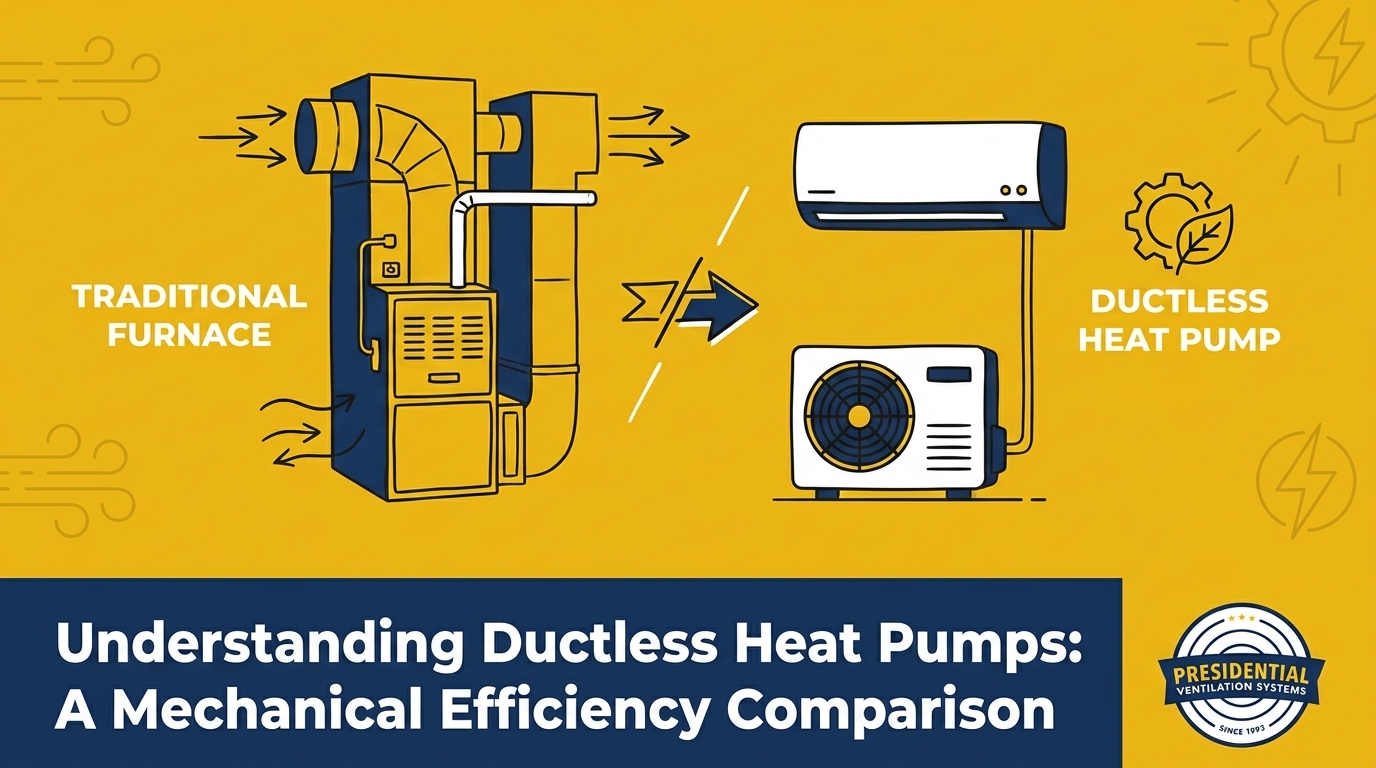
The problem: Traditional heating systems are fundamentally limited by the laws of thermodynamics related to combustion. A furnace generates heat by burning a consumable fuel—such as oil, natural gas, or propane. Even in the most advanced combustion systems, the mechanical efficiency ceiling is capped because a portion of the thermal energy is always lost through the exhaust flue along with the combustion byproducts.
The cause: Because a furnace must create heat from scratch by consuming a resource, it can never produce more energy than the fuel contains. If a furnace operates at 95% efficiency, it means 95 percent of the fuel consumed becomes usable heat, while the remaining 5 percent escapes outdoors. There is no physical way for a combustion system to exceed 100% efficiency.
The solution: Heat pumps bypass this limitation entirely by utilizing a refrigeration cycle to transfer ambient thermal energy rather than burning fuel to create it. Even during a sub-zero maritime winter, there is still measurable heat energy in the outdoor air. A heat pump uses specialized refrigerant that absorbs this dispersed ambient heat, compresses it to raise its temperature, and transfers it inside the house. Because moving existing heat requires significantly less electrical input than generating new heat, the mechanical efficiency of Lennox ductless systems and similar equipment can easily exceed 100%, often operating at 200% to 300% efficiency under normal conditions.
To accurately compare heating systems, homeowners must understand the specific metrics used to grade different mechanical technologies. You cannot directly compare a heat pump to a furnace using the same number, as they operate on completely different principles. Understanding these ratings ensures that properties in Mount Uniacke and surrounding areas are equipped with systems capable of handling local weather demands.
AFUE (Annual Fuel Utilization Efficiency): This metric applies exclusively to combustion systems like furnaces and boilers. It measures the percentage of fuel that is successfully converted into usable heat over an entire year. A high-efficiency gas furnace might achieve an AFUE rating of 98%, meaning only 2% of the energy is lost as exhaust.
HSPF (Heating Seasonal Performance Factor): This rating applies to heat pumps operating in heating mode. It calculates the total space heating required during the season divided by the total electrical energy consumed by the system. A higher HSPF rating indicates a more efficient unit that requires less electricity to move the same amount of thermal energy.
For a deeper dive into specific equipment ratings and performance metrics, reviewing a comprehensive guide to the best ductless heat pumps provides valuable context on how these numbers translate to real-world operation.
• Standard Gas Furnace — Efficiency Metric: AFUE — Maximum Efficiency Ceiling: Up to 98% — Operational Mechanism: Combustion (Burns fuel to create heat)
• Oil Furnace — Efficiency Metric: AFUE — Maximum Efficiency Ceiling: 80% - 87% — Operational Mechanism: Combustion (Burns fuel to create heat)
• Standard Heat Pump — Efficiency Metric: HSPF — Maximum Efficiency Ceiling: Up to 250% — Operational Mechanism: Heat Transfer (Moves ambient heat)
• Cold-Climate Heat Pump — Efficiency Metric: HSPF — Maximum Efficiency Ceiling: Up to 300%+ — Operational Mechanism: Enhanced Heat Transfer (Inverter-driven)
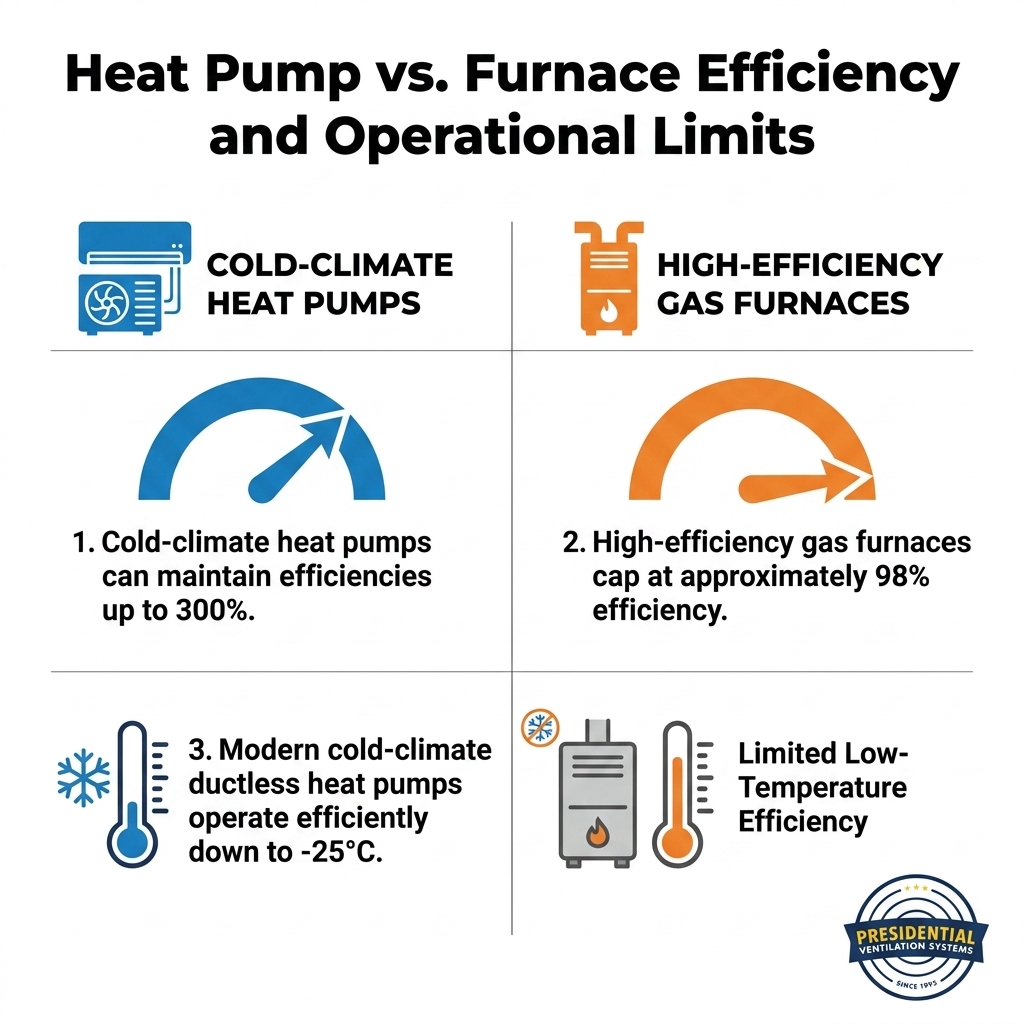
Temperature thresholds: The most critical factor in evaluating a heat pump is its objective operational limit during extreme weather. Standard heat pumps—often designed for milder southern climates—begin losing significant efficiency just below the freezing mark. As the temperature drops, there is less ambient thermal energy available, forcing the compressor to work harder to extract heat. Eventually, a standard unit reaches a balance point where it can no longer extract enough heat to keep the indoor space warm without relying on auxiliary electric resistance heating.
Cold-climate engineering: Modern cold-climate ductless heat pumps are engineered specifically to bypass these traditional limits. Utilizing advanced variable-speed inverter compressors and enhanced refrigerant management, these systems can operate efficiently in temperatures as low as -25 degrees Celsius. They physically accelerate the compressor speed to draw more thermal energy from the frigid air, maintaining indoor comfort through a sub-zero maritime winter.
Understanding these mechanical limits helps determine if a hybrid dual-fuel system or a complete transition to heat transfer is the right choice. For example, our technicians at Presidential Ventilation Systems Ltd. recently assessed a Mount Uniacke homeowner's existing, non-company installed heat pump system to evaluate its cold-weather performance. Our team explained the objective pros and cons of the current equipment's mechanical limits and offered helpful alternatives and advice for running the system efficiently despite its specific temperature thresholds.
Transitioning away from a traditional oil burner to a central or ductless heat pump system fundamentally alters a property's electrical load. A furnace primarily uses electricity just to run the blower motor, while a heat pump relies on electricity to power the heavy-duty outdoor compressor. We frequently find that older homes may require electrical panel upgrades—often moving from a 100-amp service to a 200-amp service—to safely support the continuous electrical draw of modern heating systems. Evaluating the existing electrical infrastructure is a mandatory step before committing to a heat transfer upgrade.
Cold temperatures are only one variable in the mechanical performance equation; ambient moisture plays a massive and often overlooked role. In our years of installing systems across Nova Scotia, we've found that the dampness of maritime winters requires specialized defrost capabilities, focusing on the specific challenges of high humidity combined with freezing temperatures. When a heat pump operates in heating mode, the outdoor coil becomes extremely cold—often colder than the ambient air—which causes moisture in the humid air to condense and freeze on the metal fins.
To maintain efficiency, the system must periodically clear this frost accumulation through an automatic defrost cycle. Here is the step-by-step mechanical process of how a system manages high humidity during a sub-zero maritime winter:
1. Frost Accumulation: High ambient humidity in the cold maritime air contacts the freezing outdoor condenser coils, rapidly forming a layer of frost that insulates the fins and restricts airflow.
2. Sensor Activation: Internal thermistors and solid-state control boards detect the drop in airflow and the changing temperature differential across the coil, signaling that the unit is losing efficiency.
3. Reversing the Valve: The system temporarily reverses the flow of refrigerant, shifting from heating mode to cooling mode. This redirects the hot, compressed refrigerant gas back outdoors instead of inside the house.
4. Ice Melt and Drainage: The hot refrigerant rapidly melts the accumulated ice on the outdoor coil. The resulting water must freely drain away from the base pan to prevent solid ice blocks from forming inside the chassis.
5. Resuming Heating: Once the sensors detect the coil is clear of ice, the reversing valve shifts back, and the system resumes extracting heat from the outdoor air to warm the home.
During this brief defrost period, the indoor unit temporarily stops blowing warm air. Systems engineered for damp, cold climates complete this cycle rapidly to minimize any disruption to indoor comfort.
Even the most advanced mechanical equipment will fail to reach its advertised efficiency ratings if the installation parameters are incorrect. Equipment ratings are only accurate if the system is precisely sized and installed correctly for the specific thermal envelope of the home. Certified installation practices, such as maintaining Daikin Comfort Pro status, directly impact a system's ability to maintain efficiency during extreme weather by ensuring strict adherence to manufacturer specifications.
• Precise Load Calculations: Technicians must perform detailed calculations to match the equipment capacity to the home's exact square footage, insulation levels, and window quality. Oversized units will short-cycle, while undersized units will run constantly without satisfying the thermostat.
• Strategic Outdoor Placement: Proper placement of outdoor units is critical in Mount Uniacke and surrounding areas to prevent snow burial. Units must be elevated on stands or wall brackets to allow for adequate defrost drainage and unobstructed airflow during heavy snowfall.
• Refrigerant Line Sizing: The copper lines connecting the indoor and outdoor units must be sized correctly and purged with nitrogen to prevent moisture and non-condensables from degrading the compressor oil.
• Documentation and Compliance: Navigating warranties and available rebates requires meticulous documentation during the installation phase. A recent project of ours demonstrated this full lifecycle: after providing a comprehensive quote, our installation team followed up, completed the installation, submitted the manufacturer warranty, and clearly explained the rebate process to the homeowner.
Executing these technical prerequisites accurately is why professional heat pump installations are vital for long-term mechanical reliability.
The ongoing mechanical care required for heat transfer systems differs significantly from combustion systems. Traditional furnaces require annual checks primarily focused on combustion safety. Our service technicians must inspect heat exchangers for microscopic cracks that could leak carbon monoxide, ensure the exhaust flues are drafting correctly, and clean the burner assemblies to maintain a safe flame.
Ductless systems and central heat pumps do not have combustion hazards, but they move massive volumes of air and are highly sensitive to airflow restrictions. They require frequent filter cleaning by the homeowner and professional deep cleaning of the indoor blower wheels and evaporator coils. If the micro-channel coils become clogged with household dust or pet dander, the system loses its ability to transfer heat efficiently, forcing the outdoor compressor to operate at higher pressures.
During a sub-zero maritime winter, a neglected heat pump will struggle to extract heat, leading to increased electrical consumption and premature component wear. We consistently see that preventative care directly correlates to the longevity of the compressor and the system's overall lifespan. Enrolling in a structured preventative maintenance plan ensures that both the indoor air handlers and the outdoor condenser are professionally calibrated and cleaned before the harsh weather arrives.
Choosing between a traditional combustion furnace and a modern heat transfer system comes down to understanding your home's existing infrastructure and the specific demands of the local climate. Reviewing objective options comparisons for homeowners allows you to look past the marketing language and focus on factual mechanical limits, electrical requirements, and efficiency ratings.
By evaluating how different systems handle defrost cycles, deep freezes, and ongoing maintenance, you can confidently plan your next HVAC upgrade. A clear, technically sound understanding of these operational differences ensures that the equipment you choose will provide consistent, efficient warmth. Consulting with our certified professionals at Presidential Ventilation Systems Ltd. guarantees that your chosen system is sized, placed, and installed to meet your year-round comfort expectations.
At what temperature do heat pumps lose efficiency?
Standard heat pumps typically begin to lose efficiency as temperatures drop below freezing (0°C). However, modern cold-climate heat pumps are engineered with advanced compressors that maintain high efficiency and heat output in temperatures as low as -25°C. The exact drop-off point depends heavily on the specific make and model of the equipment.
How does a maritime climate affect heat pump performance?
A damp maritime climate accelerates frost buildup on the outdoor condenser coils due to high ambient humidity. This requires the heat pump to initiate automatic defrost cycles more frequently to melt the accumulated ice. Systems installed in these regions must be specifically designed to handle rapid defrosting without severely interrupting indoor heating.
Can a heat pump replace a furnace completely?
Yes, a properly sized cold-climate heat pump can completely replace a traditional furnace in most homes. The property must have an adequate electrical panel to support the system, and the unit must be rated for the lowest expected winter temperatures in your specific region. In some cases, homeowners opt for a hybrid system that uses both technologies.
Is it better to have a heat pump or a furnace in Canada?
The better option depends on the specific region, the home's insulation, and the local cost of electricity versus fossil fuels. Cold-climate heat pumps offer superior mechanical efficiency and operate without producing carbon monoxide, making them highly effective for many Canadian homes. Furnaces may still be preferred in extreme northern climates where temperatures consistently remain below -30°C for extended periods.
Why does my heat pump's outdoor unit ice up in the winter?
It is completely normal for a thin layer of white frost to accumulate on the outdoor unit during winter operation, as the freezing coils condense moisture from the air. The system is designed to automatically melt this frost using a built-in defrost cycle. If the unit becomes encased in a solid block of thick ice that does not melt, it indicates a mechanical issue that requires professional service.
What are the electrical requirements for switching to a heat pump?
Switching from a fossil-fuel furnace to a heat pump often requires a dedicated 220-volt circuit for the outdoor compressor. Many older homes with 100-amp electrical panels need to be upgraded to 200-amp service to safely handle the increased electrical load. A certified electrician or HVAC technician must evaluate your current panel before installation.