


How salt air and coastal conditions in nova scotia affect commercial hvac equipment is one of the most important things any Halifax-area business owner needs to understand. The short answer: Nova Scotia's marine environment is one of the harshest operating conditions an HVAC system can face — and commercial equipment bears the brunt of it.
Here is a quick overview of the key impacts:
Living and working near the Atlantic Ocean comes with obvious rewards. But for the commercial HVAC systems keeping your building comfortable, that ocean breeze is a slow and relentless chemical adversary. Salt-laden air drifts inland from the harbour, settles on outdoor equipment, and quietly eats away at metal components from Eastern Passage to Hubbards.
Unlike residential systems, commercial HVAC units are larger, often roof-mounted, and exposed around the clock to wind, salt spray, and Nova Scotia's famously unpredictable weather swings. The result is accelerated wear that most standard maintenance plans simply are not designed to handle.
Understanding this damage — how it starts, where it hits hardest, and the operational impact if ignored — is the first step to protecting your equipment.
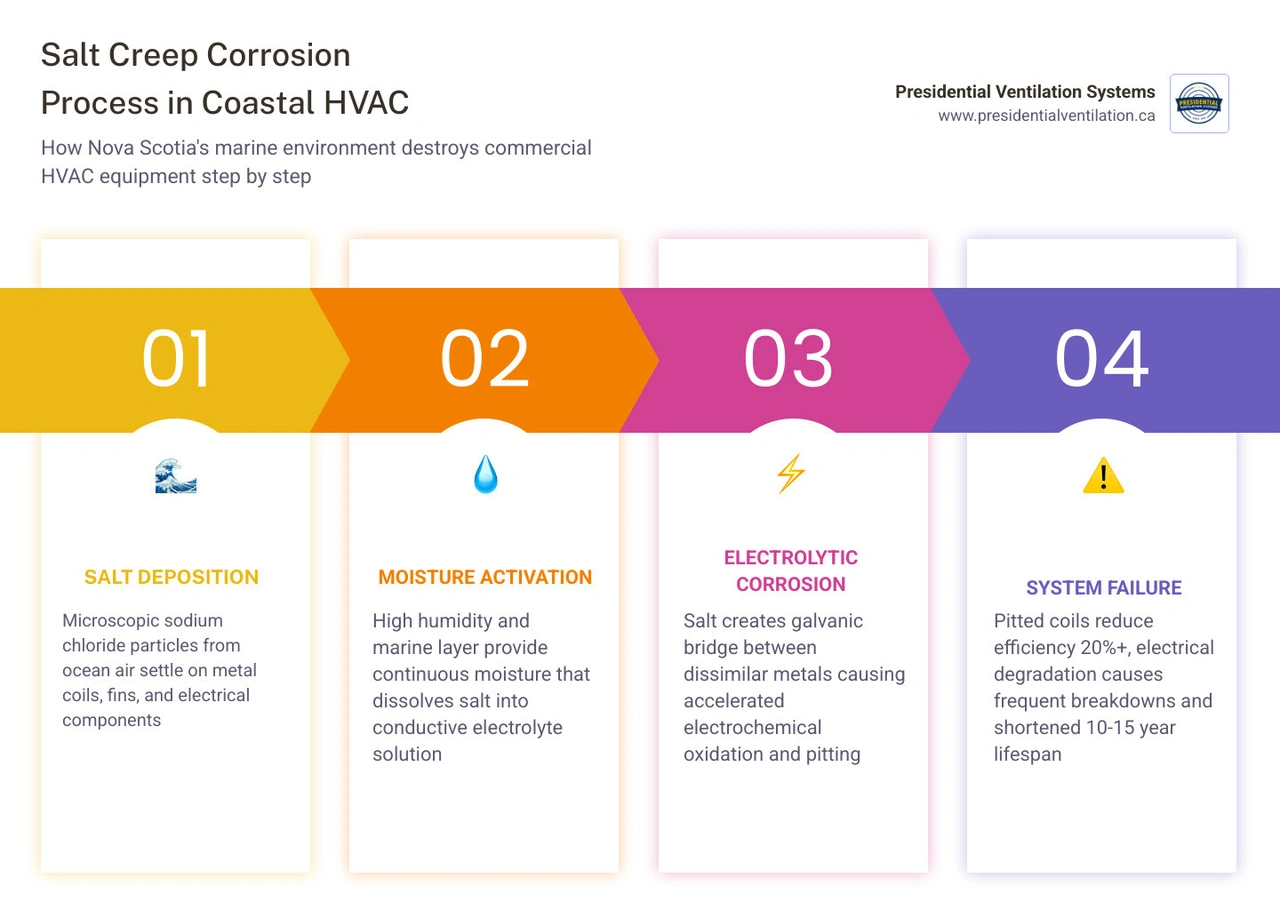
To truly understand how coastal conditions impact your building's climate control, we have to look at the chemistry of "salt creep." The marine air in coastal Nova Scotia carries microscopic sodium chloride (salt) particles. When these particles settle on the metallic surfaces of your outdoor HVAC units, they do not just sit there—they act as a highly conductive chemical bridge.
In the presence of moisture (which is never in short supply in places like downtown Halifax or Eastern Passage), these salt particles trigger a process known as electrolytic or galvanic corrosion. This is an electrochemical reaction where electrons flow more freely between different metal components, such as aluminum fins and copper tubing. This accelerated oxidation eats away at the metal, causing pitting, structural weakness, and eventual system failure.
The operational toll of this chemical process is substantial:
To prevent these issues from catching your business off guard, it is vital to work with experienced local professionals who understand these regional challenges. Implementing a proactive plan for Commercial HVAC Halifax ensures your system is equipped to handle the unique demands of our coastal environment.
Nova Scotia’s maritime climate is incredibly unique, meaning our local commercial systems face a "triple threat" of environmental stressors that inland systems never have to contend with. In the Halifax Regional Municipality (HRM), several distinct coastal factors work together to accelerate equipment wear:
For businesses operating in these areas, standard off-the-shelf equipment simply will not hold up. Designing systems tailored to these microclimates is essential, which is why choosing specialized services for Commercial HVAC Bedford is a smart decision for long-term reliability.
The condenser and evaporator coils are the literal heart of your commercial cooling and ventilation systems. Unfortunately, they are also the most vulnerable to salt air damage.
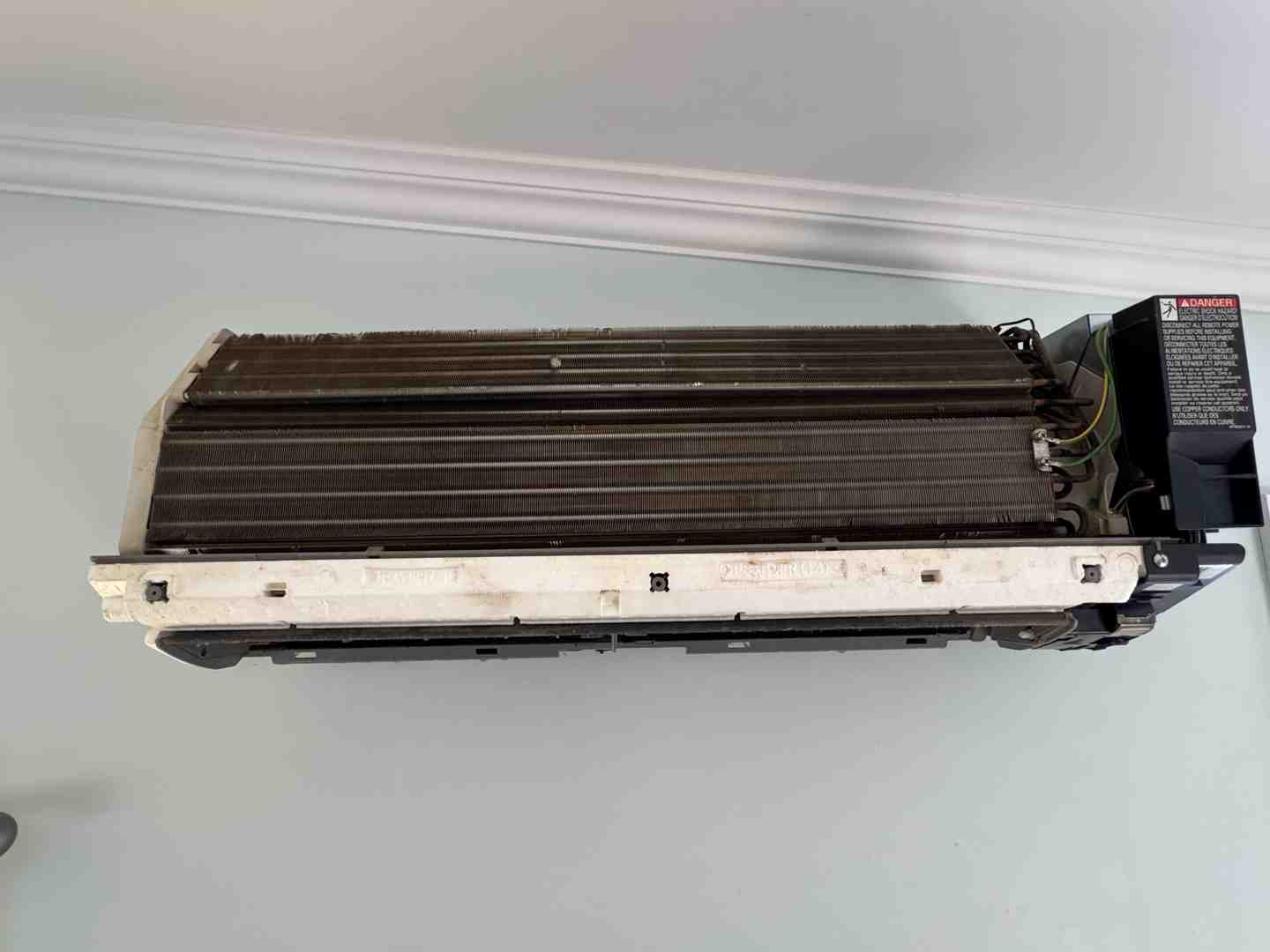
Most standard commercial outdoor units utilize a combination of copper tubing threaded through thin aluminum fins. While this design is excellent for heat transfer, it is highly susceptible to galvanic corrosion in a marine environment.
When salt air settles into the tight spaces between the aluminum fins and copper tubes, it initiates a process called pitting. Pitting creates microscopic holes in both the aluminum and the copper. Over time, these tiny pits merge, leading to:
Protecting these delicate components starts at the very beginning. Investing in high-quality, marine-grade equipment and securing a professional Commercial HVAC Installation is the best way to ensure your coils are protected from day one.
While the physical destruction of metal coils is easy to see, salt air also wage a silent war on your system's electrical components. Salt fog is highly conductive. When humid, salt-laden air penetrates the electrical cabinets of outdoor commercial units, it leaves behind a conductive film over delicate electronics.
This leads to several common electrical failures:
To mitigate this, commercial systems in coastal zones should utilize control boards treated with conformal coatings—a specialized protective silicone or epoxy sealant that seals the electronics away from moisture and salt. Regular inspections and timely Commercial Electrical Repairs are vital to catching these issues before a minor short-circuit turns into a major system-wide failure.
Because commercial HVAC equipment is often located on rooftops or in dedicated mechanical rooms, coastal damage can easily go unnoticed until a catastrophic failure occurs. Business owners and facility managers in the HRM should keep a close eye out for these common warning signs:
Ignoring these early warning signs can lead to major operational disruptions. Reviewing a comprehensive resource like the Commercial Ventilation Halifax Ultimate Guide can help you identify these symptoms early, and if you suspect your system is already struggling, checking our guide on Commercial Systems Not Working in Halifax NS can help you troubleshoot the next steps.
Operating a commercial HVAC system successfully in coastal Nova Scotia requires a proactive, "Maritime-tough" maintenance strategy. You cannot treat a coastal system the same way you would a system located miles inland.
Here are the most effective protective strategies to extend the life of your equipment:
To keep your system running at peak performance, scheduling a regular Commercial HVAC Tune Up is essential.
To help you understand the difference in equipment specifications, here is a comparison of standard commercial equipment versus systems designed for coastal duty:
| Feature | Standard-Duty HVAC | Coastal-Duty HVAC |
|---|---|---|
| Coil Protection | Untreated aluminum fins | Epoxy, e-coated, or "Golden Fin" coated coils |
| Cabinet Fasteners | Standard galvanized steel screws | Marine-grade stainless steel fasteners |
| Circuit Boards | Uncoated electronics | Conformal-coated PCBs (sealed against moisture) |
| Enclosure Coating | Standard powder paint | Multi-layer, salt-spray-rated protective finish |
| Maintenance Needs | Annual inspection | Bi-annual or quarterly deep cleaning & rinsing |
While residential systems certainly suffer from salt air, commercial systems face a much higher level of risk due to their size, design, and location:
Managing these large-scale systems requires specialized commercial expertise. For tailored business solutions, exploring dedicated Commercial Ventilation Solutions is key. Additionally, keeping a structured service routine via our Commercial Central System Maintenance Guide in Halifax NS will ensure your larger commercial units remain reliable year-round.
Salt air causes electrolytic corrosion on the metal fins of your condenser coils. As these fins corrode and pit, they lose their thermal conductivity. This means the system cannot dissipate heat efficiently, forcing the compressor and blower motors to run longer and work harder. This drop in heat transfer efficiency can increase your building's energy consumption by 20% or more before the system ultimately breaks down.
In inland regions, an annual service visit is often sufficient. However, for commercial properties in coastal Nova Scotia (especially those within 1,500 feet of tidal waters, such as Eastern Passage, downtown Halifax, or Bedford), we highly recommend a bi-annual or even quarterly maintenance schedule. Regular professional cleaning to neutralize salt deposits is vital to preventing premature equipment failure.
The most effective protective coatings for marine environments are specialized epoxy-based, polyurethane, or silane-based coatings (often referred to in the industry as e-coatings, "Blue Fin," or "Golden Fin" technology). These coatings are designed to be incredibly thin so they do not interfere with heat transfer, yet they provide a highly durable, hydrophobic barrier that prevents salt and moisture from contacting the raw metal.
Operating a business in coastal Nova Scotia means accepting the challenges that come with our beautiful, rugged environment. Salt air, high humidity, and rapid temperature swings are a constant threat to your commercial HVAC equipment. Left unmanaged, coastal corrosion will quietly steal your system's efficiency, drive up your energy usage, and lead to premature equipment failure.
At Presidential Ventilation Systems Ltd., we bring over 30 years of local experience to helping businesses across the Halifax Regional Municipality navigate these harsh maritime conditions. From custom duct design and advanced air balancing to specialized marine-grade coatings and tailored commercial maintenance plans, we ensure your building's ventilation systems are truly "Maritime-tough."
Do not let the ocean breeze slowly erode your system's reliability. Contact us today to secure your building's comfort, protect your equipment, and learn more about our specialized Commercial Ventilation and HVAC Systems.

How salt air and coastal conditions in nova scotia affect commercial hvac equipment is one of the most important things any Halifax-area business owner needs to understand. The short answer: Nova Scotia's marine environment is one of the harshest operating conditions an HVAC system can face — and commercial equipment bears the brunt of it.
Here is a quick overview of the key impacts:
Living and working near the Atlantic Ocean comes with obvious rewards. But for the commercial HVAC systems keeping your building comfortable, that ocean breeze is a slow and relentless chemical adversary. Salt-laden air drifts inland from the harbour, settles on outdoor equipment, and quietly eats away at metal components from Eastern Passage to Hubbards.
Unlike residential systems, commercial HVAC units are larger, often roof-mounted, and exposed around the clock to wind, salt spray, and Nova Scotia's famously unpredictable weather swings. The result is accelerated wear that most standard maintenance plans simply are not designed to handle.
Understanding this damage — how it starts, where it hits hardest, and the operational impact if ignored — is the first step to protecting your equipment.
To truly understand how coastal conditions impact your building's climate control, we have to look at the chemistry of "salt creep." The marine air in coastal Nova Scotia carries microscopic sodium chloride (salt) particles. When these particles settle on the metallic surfaces of your outdoor HVAC units, they do not just sit there—they act as a highly conductive chemical bridge.
In the presence of moisture (which is never in short supply in places like downtown Halifax or Eastern Passage), these salt particles trigger a process known as electrolytic or galvanic corrosion. This is an electrochemical reaction where electrons flow more freely between different metal components, such as aluminum fins and copper tubing. This accelerated oxidation eats away at the metal, causing pitting, structural weakness, and eventual system failure.
The operational toll of this chemical process is substantial:
To prevent these issues from catching your business off guard, it is vital to work with experienced local professionals who understand these regional challenges. Implementing a proactive plan for Commercial HVAC Halifax ensures your system is equipped to handle the unique demands of our coastal environment.
Nova Scotia’s maritime climate is incredibly unique, meaning our local commercial systems face a "triple threat" of environmental stressors that inland systems never have to contend with. In the Halifax Regional Municipality (HRM), several distinct coastal factors work together to accelerate equipment wear:
For businesses operating in these areas, standard off-the-shelf equipment simply will not hold up. Designing systems tailored to these microclimates is essential, which is why choosing specialized services for Commercial HVAC Bedford is a smart decision for long-term reliability.
The condenser and evaporator coils are the literal heart of your commercial cooling and ventilation systems. Unfortunately, they are also the most vulnerable to salt air damage.
Most standard commercial outdoor units utilize a combination of copper tubing threaded through thin aluminum fins. While this design is excellent for heat transfer, it is highly susceptible to galvanic corrosion in a marine environment.
When salt air settles into the tight spaces between the aluminum fins and copper tubes, it initiates a process called pitting. Pitting creates microscopic holes in both the aluminum and the copper. Over time, these tiny pits merge, leading to:
Protecting these delicate components starts at the very beginning. Investing in high-quality, marine-grade equipment and securing a professional Commercial HVAC Installation is the best way to ensure your coils are protected from day one.
While the physical destruction of metal coils is easy to see, salt air also wage a silent war on your system's electrical components. Salt fog is highly conductive. When humid, salt-laden air penetrates the electrical cabinets of outdoor commercial units, it leaves behind a conductive film over delicate electronics.
This leads to several common electrical failures:
To mitigate this, commercial systems in coastal zones should utilize control boards treated with conformal coatings—a specialized protective silicone or epoxy sealant that seals the electronics away from moisture and salt. Regular inspections and timely Commercial Electrical Repairs are vital to catching these issues before a minor short-circuit turns into a major system-wide failure.
Because commercial HVAC equipment is often located on rooftops or in dedicated mechanical rooms, coastal damage can easily go unnoticed until a catastrophic failure occurs. Business owners and facility managers in the HRM should keep a close eye out for these common warning signs:
Ignoring these early warning signs can lead to major operational disruptions. Reviewing a comprehensive resource like the Commercial Ventilation Halifax Ultimate Guide can help you identify these symptoms early, and if you suspect your system is already struggling, checking our guide on Commercial Systems Not Working in Halifax NS can help you troubleshoot the next steps.
Operating a commercial HVAC system successfully in coastal Nova Scotia requires a proactive, "Maritime-tough" maintenance strategy. You cannot treat a coastal system the same way you would a system located miles inland.
Here are the most effective protective strategies to extend the life of your equipment:
To keep your system running at peak performance, scheduling a regular Commercial HVAC Tune Up is essential.
To help you understand the difference in equipment specifications, here is a comparison of standard commercial equipment versus systems designed for coastal duty:
| Feature | Standard-Duty HVAC | Coastal-Duty HVAC |
|---|---|---|
| Coil Protection | Untreated aluminum fins | Epoxy, e-coated, or "Golden Fin" coated coils |
| Cabinet Fasteners | Standard galvanized steel screws | Marine-grade stainless steel fasteners |
| Circuit Boards | Uncoated electronics | Conformal-coated PCBs (sealed against moisture) |
| Enclosure Coating | Standard powder paint | Multi-layer, salt-spray-rated protective finish |
| Maintenance Needs | Annual inspection | Bi-annual or quarterly deep cleaning & rinsing |
While residential systems certainly suffer from salt air, commercial systems face a much higher level of risk due to their size, design, and location:
Managing these large-scale systems requires specialized commercial expertise. For tailored business solutions, exploring dedicated Commercial Ventilation Solutions is key. Additionally, keeping a structured service routine via our Commercial Central System Maintenance Guide in Halifax NS will ensure your larger commercial units remain reliable year-round.
Salt air causes electrolytic corrosion on the metal fins of your condenser coils. As these fins corrode and pit, they lose their thermal conductivity. This means the system cannot dissipate heat efficiently, forcing the compressor and blower motors to run longer and work harder. This drop in heat transfer efficiency can increase your building's energy consumption by 20% or more before the system ultimately breaks down.
In inland regions, an annual service visit is often sufficient. However, for commercial properties in coastal Nova Scotia (especially those within 1,500 feet of tidal waters, such as Eastern Passage, downtown Halifax, or Bedford), we highly recommend a bi-annual or even quarterly maintenance schedule. Regular professional cleaning to neutralize salt deposits is vital to preventing premature equipment failure.
The most effective protective coatings for marine environments are specialized epoxy-based, polyurethane, or silane-based coatings (often referred to in the industry as e-coatings, "Blue Fin," or "Golden Fin" technology). These coatings are designed to be incredibly thin so they do not interfere with heat transfer, yet they provide a highly durable, hydrophobic barrier that prevents salt and moisture from contacting the raw metal.
Operating a business in coastal Nova Scotia means accepting the challenges that come with our beautiful, rugged environment. Salt air, high humidity, and rapid temperature swings are a constant threat to your commercial HVAC equipment. Left unmanaged, coastal corrosion will quietly steal your system's efficiency, drive up your energy usage, and lead to premature equipment failure.
At Presidential Ventilation Systems Ltd., we bring over 30 years of local experience to helping businesses across the Halifax Regional Municipality navigate these harsh maritime conditions. From custom duct design and advanced air balancing to specialized marine-grade coatings and tailored commercial maintenance plans, we ensure your building's ventilation systems are truly "Maritime-tough."
Do not let the ocean breeze slowly erode your system's reliability. Contact us today to secure your building's comfort, protect your equipment, and learn more about our specialized Commercial Ventilation and HVAC Systems.
Knowing what to look for in a commercial HVAC maintenance provider in Nova Scotia can mean the difference between a building that runs smoothly year-round and one that faces costly breakdowns at the worst possible moments. With 42 HVAC contractors operating in the Halifax Regional Municipality alone, the choice is far from simple.
Nova Scotia's maritime climate is hard on commercial ventilation systems. Salt air accelerates coil corrosion. Humidity swings stress equipment. Cold winters and humid summers push systems to their limits. The wrong provider — one without the right credentials, local knowledge, or service depth — can leave your building uncomfortable, your warranty void, and your energy bills climbing.
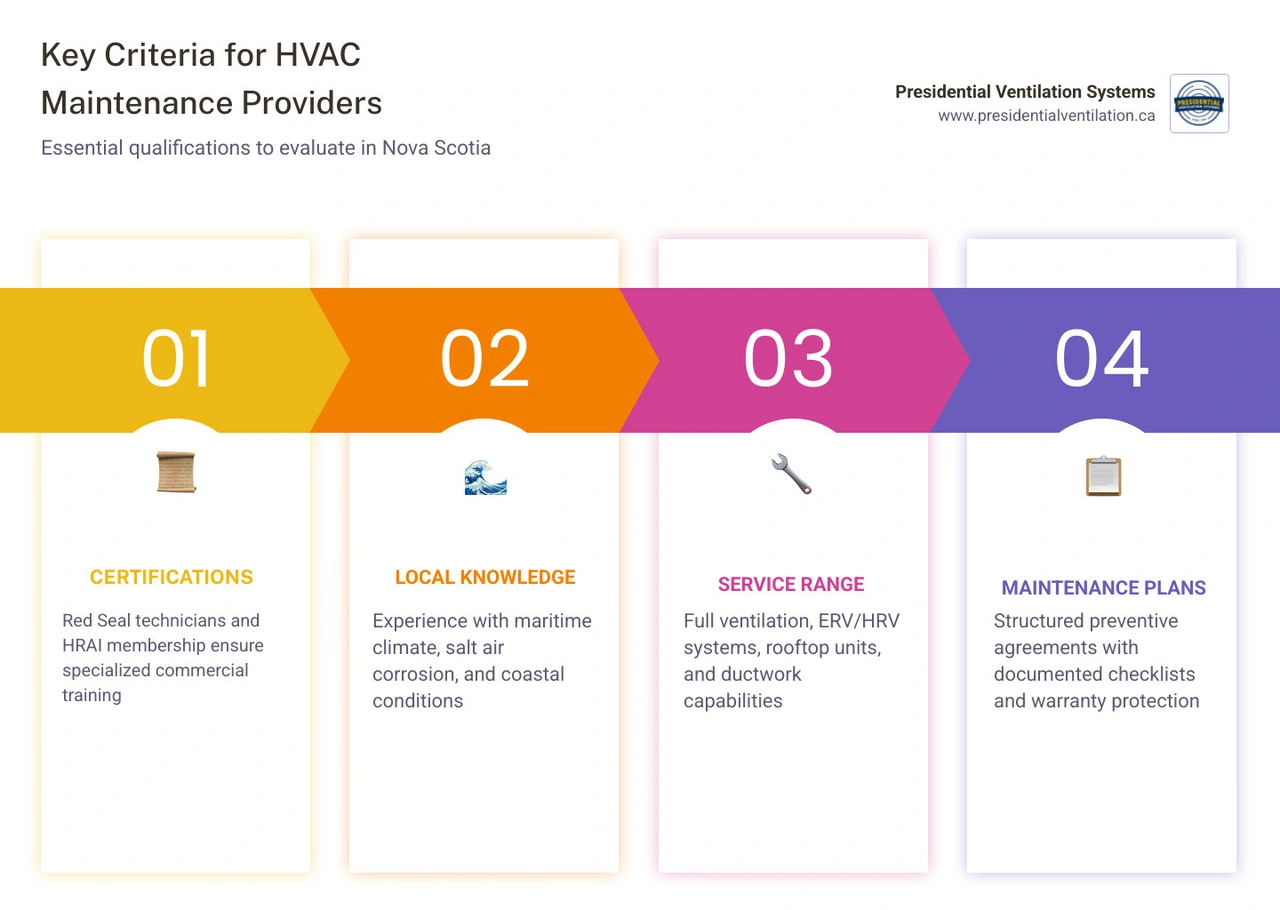
Here is a quick summary of the most important factors to evaluate:
Preventive maintenance alone can save businesses 5% to 20% on energy bills, and well-maintained systems regularly last well beyond the typical 15-to-20-year lifespan. Getting the provider selection right from the start protects that investment for the long term.
When evaluating commercial ventilation and air handling service providers across the province, specialized qualifications must be at the top of your list. Commercial HVAC systems operate under significantly heavier loads and longer hours than standard residential units. Because of this complexity, the technicians working on your facility's equipment must possess advanced, specialized training.
In Nova Scotia, HVAC work can only be legally performed by licensed and trained professionals. As you begin your search, look for providers whose technicians hold Red Seal certifications. The Red Seal program is the gold standard across Canada, ensuring that a journeyperson has met high national standards of technical knowledge and practical skill.
Additionally, look for active membership in the Heating, Refrigeration and Air Conditioning Institute of Canada (HRAI). Membership in this national association demonstrates that a contractor is committed to professional development, safe environmental practices, and compliance with the latest national building codes.
Selecting a provider with these verified qualifications ensures that your building's complex ventilation, makeup air, and exhaust systems are handled safely and efficiently. To help you narrow down your search in the local market, you can read our guide on how to Find Me the Top Rated Commercial HVAC Companies in Halifax.
A top-tier commercial ventilation provider must offer more than basic filter changes. They should possess deep technical expertise in air distribution, custom sheet metal fabrication, and system design.
Commercial buildings often suffer from poor air distribution, which leads to hot and cold spots, stuffy boardrooms, or lingering odors in commercial kitchens. To resolve these issues, your maintenance provider must understand the science of air balancing. Air balancing involves testing and adjusting your system's blowers, dampers, and registers to ensure the correct volume of fresh air is delivered to every zone in your facility.
Furthermore, because commercial spaces frequently undergo renovations, tenant fit-ups, or layout changes, your provider should have in-house custom duct design and sheet metal fabrication capabilities. When ductwork is poorly designed or improperly sized, it restricts airflow, strains fan motors, and increases energy waste. A provider capable of fabricating custom fittings on-demand can optimize your system’s performance during upgrades or repairs. For complex commercial properties, partnering with a contractor who specializes in custom, high-efficiency system design is vital during a Commercial HVAC Installation.
Nova Scotia's geography presents highly specific environmental challenges that do not exist in inland provinces. If you operate a facility in Halifax, Dartmouth, Eastern Passage, or any of our coastal communities, your ventilation systems are constantly exposed to salt-laden ocean air.
Salt air is highly corrosive to the delicate aluminum and copper coils found in commercial air handlers and rooftop units. Without specialized care, this coastal exposure leads to rapid coil oxidation, pitting, and premature equipment failure. A local provider with decades of experience in Nova Scotia knows how to identify early signs of salt-air damage and will perform specialized coil cleanings to neutralize corrosive salt deposits.
Our local weather also brings dramatic humidity swings. Summers are often thick with coastal fog and high humidity, while winters can be bitterly cold and dry. Your commercial ventilation systems must be precisely calibrated to manage these seasonal shifts, preventing indoor mold growth in August and dry, static-filled air in January. To understand how our local environment impacts your building's equipment, read our detailed guide on How Salt Air and Coastal Conditions in Nova Scotia Affect Commercial HVAC Equipment.
A truly qualified commercial service provider must be a one-stop shop for all of your building’s air handling and ventilation needs. Commercial facilities rely on a diverse mix of interconnected systems to maintain safety, comfort, and indoor air quality.
For single-story retail spaces, restaurants, and warehouses, Commercial Rooftop Units (RTUs) are the workhorses of climate control. These self-contained units handle heating, cooling, and ventilation from a single location on the roof. Your maintenance provider must be fully equipped to handle the unique challenges of RTUs, including weathering, wind loads, and outdoor damper operations.
For larger or multi-zoned facilities, such as office buildings in Bedford or institutional properties in Halifax, Variable Refrigerant Flow (VRF) systems provide highly precise zone control. These systems circulate refrigerant to multiple indoor air handlers, allowing you to cool one zone while ventilating another.
Beyond heating and cooling, your provider must master makeup air and exhaust systems. Commercial kitchens, manufacturing plants, and high-occupancy spaces generate large volumes of heat, smoke, moisture, or chemical fumes. Powerful exhaust systems are required to pull this air out of the building safely, while makeup air systems must simultaneously bring in fresh, tempered outdoor air to maintain proper building pressure. To explore the full range of custom air handling systems available for your business, check out our Commercial Ventilation Solutions.
In modern commercial buildings, energy efficiency and indoor air quality go hand in hand. Bringing in fresh outdoor air to keep employees and customers healthy can require significant energy to heat or cool that air to room temperature. This is where Energy Recovery Ventilators (ERVs) and Heat Recovery Ventilators (HRVs) become essential.
HRVs and ERVs work by capturing the heating or cooling energy from the stale, outgoing exhaust air and transferring it to the incoming fresh air. This continuous air exchange ensures that your building maintains excellent indoor air quality without placing an excessive load on your main heating and cooling systems.
Regular maintenance of these recovery ventilators is critical. If the heat exchange cores become clogged with dust, pollen, or debris, the efficiency of the heat transfer drops dramatically, and airflow is restricted. A professional maintenance provider will inspect, clean, and tune your ERV and HRV units to keep your indoor air fresh and dry. For businesses in the Halifax area, scheduling regular service is simple with our guide on Commercial Ventilation Maintenance Halifax NS.
Commercial ventilation systems do not operate in a vacuum; they are deeply integrated with your building's electrical infrastructure and control systems. Many commercial air handlers and rooftop units utilize complex three-phase electrical systems, variable frequency drives (VFDs), and computerized Building Automation Systems (BAS).
When a ventilation system malfunctions, the root cause is often electrical rather than mechanical. A loose wire, a failed contactor, or a faulty sensor can bring a massive air handling unit to a complete halt.
Choosing a commercial maintenance provider that offers integrated multi-trade support — including commercial electrical services — provides a massive advantage. Instead of waiting for an HVAC technician to diagnose a problem, only to then have to call a separate electrical contractor to fix the power supply, an integrated team can diagnose and repair both electrical and mechanical issues in a single visit. This cross-trade expertise is especially valuable in industrial parks like Burnside, where downtime directly impacts production. Learn more about protecting your facility's electrical infrastructure with our resources on Commercial Electrical Repairs and our Commercial Electrical Guide Burnside NS.
A reactive "wait-for-it-to-break" approach to commercial building maintenance is a recipe for operational disruption. Preventive maintenance agreements (PMAs) are structured service contracts designed to keep your systems running at peak performance while catching minor issues before they turn into major system failures.
A well-structured agreement should outline exactly what services will be performed, how often technicians will visit your facility, and what documentation you will receive. For most commercial properties in Nova Scotia, a quarterly maintenance schedule is the industry standard. High-occupancy or high-demand facilities — such as medical offices, restaurants, or laboratory spaces — may require monthly inspections.
To help you understand the value of proactive planning, we have outlined the core differences between quarterly and annual maintenance tasks below:
| Maintenance Frequency | Key Tasks Performed | Core Business Benefits |
|---|---|---|
| Quarterly Visits | Filter replacements, belt tension adjustments, condensate drain flushing, visual damper inspections, and baseline static pressure checks. | Maintains optimal indoor air quality, prevents water damage from clogged drains, and keeps fan motors running efficiently. |
| Annual Visits | Deep coil cleaning, electrical terminal tightening, fan blower balancing, sensor calibration, and full system performance testing. | Maximizes energy efficiency, prevents major electrical failures, and secures compliance with equipment manufacturer warranties. |
A preventive agreement not only keeps your building comfortable but also acts as an investment shield. To learn more about how structured service agreements protect your bottom line, read How a Maintenance Agreement Extends Commercial HVAC Equipment Lifespan.
No two commercial buildings are identical. A retail store in Bedford has vastly different ventilation requirements than a manufacturing plant in Burnside or a multi-unit residential building in downtown Halifax. Therefore, you should avoid any provider that offers a generic, one-size-fits-all maintenance checklist.
The best providers will conduct a thorough inventory of your facility's equipment and design a customized checklist tailored to your specific building layout, occupancy levels, and equipment types.
For example, a checklist for a retail space in Bedford will focus heavily on maintaining consistent airflow across large open areas and ensuring proper ventilation during peak shopping hours. You can read more about tailoring services for these properties in our guide to Commercial HVAC Bedford. Meanwhile, a checklist for an industrial facility will prioritize heavy-duty exhaust fan maintenance and makeup air calibration. Regardless of your building type, ensuring your provider performs a comprehensive Commercial HVAC Tune Up is the key to year-round reliability.
For most commercial facilities in Nova Scotia, we recommend scheduling maintenance at least four times a year (quarterly). The changing of the seasons in our maritime climate brings rapid shifts in temperature and humidity, which places different demands on your air handling equipment.
Spring visits focus on preparing cooling and ventilation systems for summer humidity, summer visits ensure heavy-duty exhaust systems are running smoothly, autumn visits prepare heating and fresh air exchange systems for the cold weather, and winter visits focus on maintaining optimal indoor air quality when the building is sealed tight. High-demand facilities like commercial kitchens or medical offices may require monthly service.
Commercial ventilation maintenance is significantly more complex than residential service. Commercial buildings use larger, heavier equipment — such as rooftop units and massive makeup air handlers — that require specialized rigging, safety protocols, and technical knowledge to service.
Additionally, commercial systems utilize three-phase electrical power, variable frequency drives, and intricate duct networks with motorized dampers to manage multiple zones. Residential systems, on the other hand, are typically single-phase, single-zone systems. Commercial maintenance also requires strict compliance with provincial building codes, ASHRAE standards, and workplace safety regulations.
Air balancing is the process of adjusting your ventilation system to ensure that the correct volume of fresh, conditioned outdoor air is delivered to every room in your building. When a system is out of balance, some areas may become pressurized (forcing air out through doors and windows) while others become depressurized (drawing unconditioned, humid, or dusty air in through the building envelope).
Proper air balancing eliminates stagnant air pockets, prevents the buildup of carbon dioxide and indoor pollutants, manages indoor humidity, and ensures that fresh air is distributed evenly. This directly improves occupant comfort, reduces employee fatigue, and prevents the growth of mold and mildew in damp areas.
Choosing the right commercial HVAC maintenance provider in Nova Scotia is one of the most critical decisions a building owner or facility manager can make. From verifying Red Seal certifications and HRAI membership to ensuring your partner understands the corrosive effects of our coastal salt air, the criteria you establish today will protect your building's comfort, air quality, and operational efficiency for years to come.
At Presidential Ventilation Systems Ltd., we bring over 30 years of local experience to every commercial facility we serve across the Halifax Regional Municipality and surrounding areas. As a trusted partner for local businesses, we specialize in custom ventilation design, air balancing, energy recovery systems, and integrated electrical support.
Let us help you transition from reactive repairs to proactive peace of mind. To secure your building's comfort and protect your equipment investments, explore our tailored commercial service agreements and sign up for a Presidential Ventilation Maintenance Plan today.
How proper hvac design in new construction affects efficiency and comfort for decades comes down to one core idea: the decisions made before the walls close determine how well your home breathes, heats, cools, and performs for the entire life of the building.
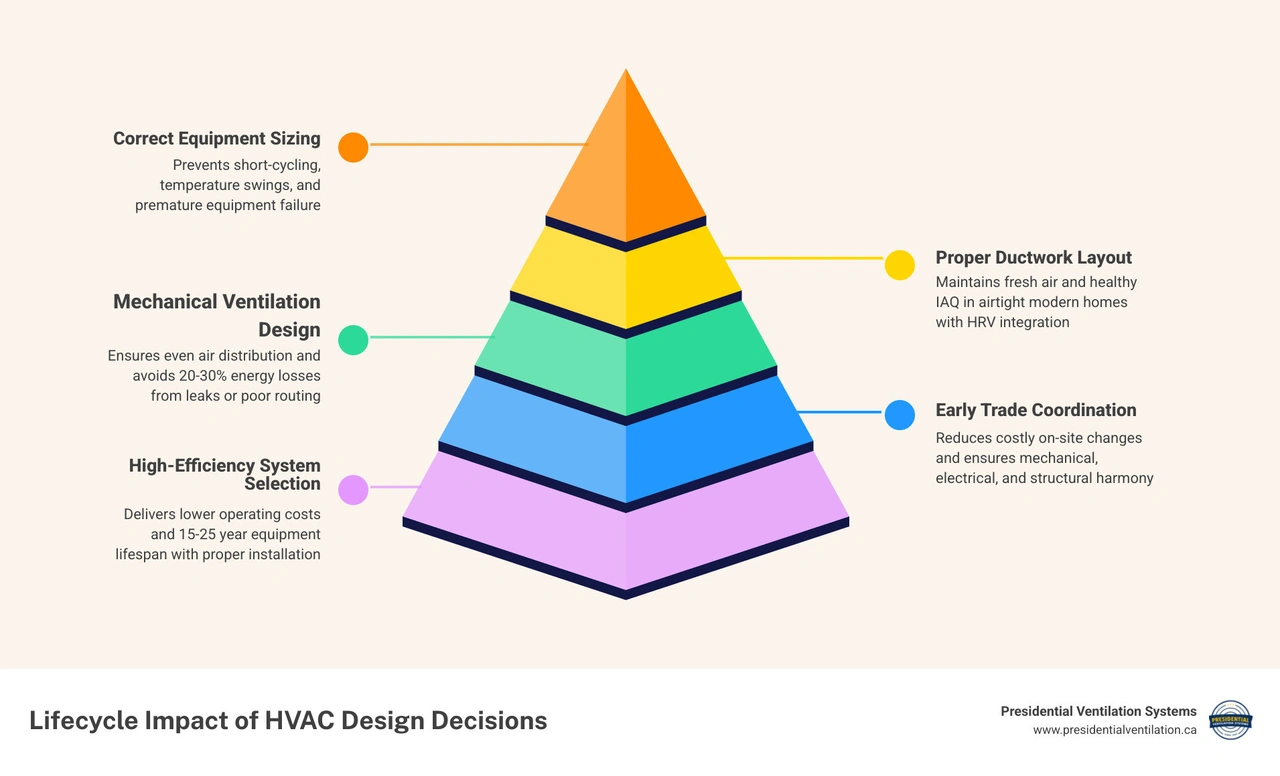
Here is a quick summary of the key ways early HVAC design shapes long-term outcomes:
Most people think of HVAC as something that gets figured out near the end of a build. In reality, the opposite is true. By the time framing is complete, many of the most important decisions — where ducts will run, how much fresh air the home will receive, whether the system will be properly sized for the actual load — have already been made or missed entirely.
Buildings account for roughly 40% of global energy consumption, and HVAC systems are responsible for about half of that. Getting the design right from the start is not just a comfort issue. It is a financial one that compounds over decades.
Designing a high-performing mechanical system requires a deep understanding of building physics, local climate conditions, and the unique architectural features of the home. When we design systems for new builds, we do not rely on guesses or old rules of thumb. Instead, we treat the house as an integrated system where the building envelope and the mechanical equipment must work in perfect harmony.
Our local climate in Atlantic Canada brings a unique set of challenges. From damp, foggy spring mornings to freezing winter blizzards and humid summer afternoons, our homes must withstand rapid shifts in weather. This is why selecting the best heating setup for Nova Scotia weather requires a careful balance of powerful performance and high-efficiency operation.
One of the most common and damaging mistakes in new construction is improper equipment sizing. For decades, many builders relied on simple square-footage estimates—such as the "5,000 BTU per 1,000 square feet" rule of thumb—to select heating and cooling equipment. Today, we know that these rough estimates are highly inaccurate and lead to chronic system issues.
To determine the exact needs of a modern home, we perform detailed Manual J load calculations. This engineering standard calculates the precise amount of heating and cooling a home requires by analyzing several factors:
Without these calculations, systems are almost always oversized. An oversized system will satisfy the thermostat too quickly and shut down, a process known as short-cycling. This rapid on-and-off cycling prevents the system from running long enough to remove moisture from the air, resulting in a cold, clammy indoor environment. Furthermore, short-cycling causes extreme wear and tear on electrical components and compressors, drastically shortening the equipment's lifespan. By investing in a properly sized home comfort system, you ensure the system runs in its optimal efficiency zone, providing continuous comfort and lasting for decades.
Modern building codes in Canada have evolved to place a heavy emphasis on energy conservation and airtightness. Today's homes are built with advanced house wraps, continuous exterior insulation, and high-performance windows, creating an incredibly tight building envelope.
While an airtight home is excellent for preventing drafts and reducing heat loss, it completely changes how we must approach mechanical design. In an older, drafty home, fresh air leaked in naturally through gaps in the construction. In a modern airtight home, there is virtually no natural air exchange. This means the mechanical system must be designed to actively manage ventilation, indoor air quality, and humidity levels.
Meeting or exceeding these building standards is not just about passing a municipal inspection. It is about ensuring your home remains structurally sound and healthy to live in for the long haul. Poorly designed systems in airtight homes can lead to trapped moisture, stagnant air, and structural decay over time. Proper engineering from the blueprint phase ensures full compliance with local energy standards while protecting your investment.
When you build a new home, you are making decisions that will influence your daily comfort and monthly bills for the next 20 to 30 years. The mechanical design is the single most influential factor in determining whether your home will be a cozy, cost-effective sanctuary or a source of constant drafts, hot spots, and high utility bills.
By selecting an energy efficient HVAC system during the planning stages, you establish a baseline of low energy consumption that pays dividends year after year.
How proper hvac design in new construction affects efficiency and comfort for decades is most visible in how the system handles daily temperature swings and humidity.
When a system is designed with precise load calculations, it operates with longer, gentler cycles. This continuous, low-speed airflow keeps temperatures perfectly consistent from room to room, eliminating the annoying hot and cold spots common in poorly designed homes.
In addition to temperature control, proper sizing is the key to moisture management. In our coastal climate, managing humidity is essential for comfort and mold prevention. A properly sized system runs long enough to pull moisture out of the air, keeping indoor relative humidity in the ideal 30% to 50% range. This reduces the load on your body's natural cooling system, allowing you to feel comfortable at slightly higher thermostat settings in the summer, which saves even more energy.
The financial benefits of a professionally designed system extend far beyond monthly utility savings. While a well-designed system can easily save you hundreds of dollars annually on energy bills, the long-term lifecycle savings are even more significant:
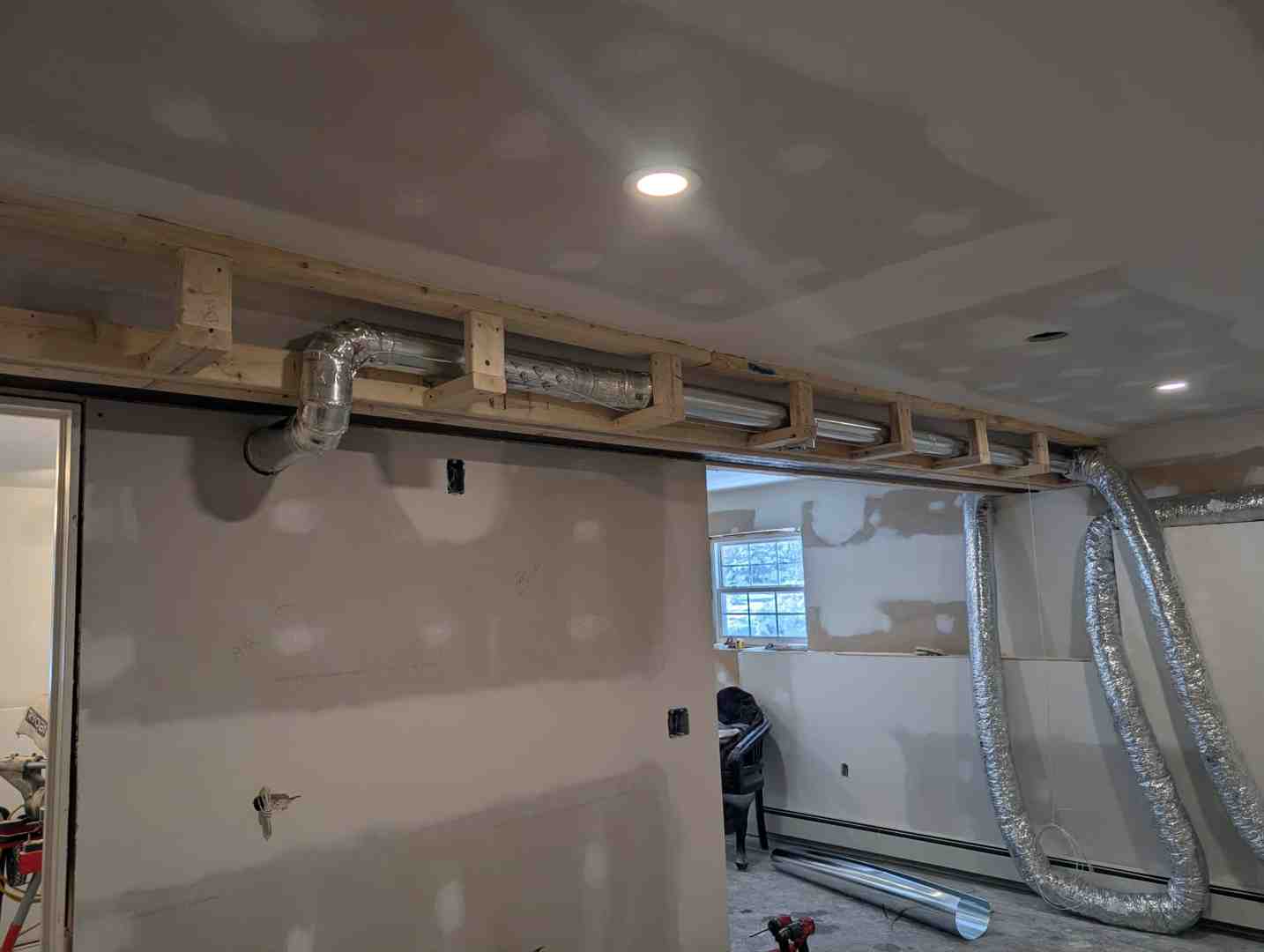
Ductwork serves as the respiratory tract of your home. You can purchase the most efficient heating and cooling unit on the market, but if it is connected to a poorly designed duct system, it will never perform as intended. In fact, standard industry studies show that poorly designed or leaky ductwork can easily waste 20% to 30% of your system's total energy output.
To prevent this, we design and manufacture custom duct systems using the custom ductwork design Halifax NS process. This ensures that every trunk, branch, and transition is engineered to match the exact airflow requirements of your home.
Achieving quiet, balanced airflow requires a careful understanding of static pressure and air velocity. If ductwork is too small, the air must move at high speeds to satisfy the system, resulting in noisy registers that sound like a jet engine taking off. Conversely, if ducts are too large, air velocity drops, and the air will struggle to reach the furthest rooms in the house.
Our approach to duct design relies on strict engineering principles to maintain optimal pressure throughout the system. By referencing a comprehensive ductwork installation guide Bedford NS, we ensure that:
When planning a new home, one of the first major mechanical decisions is choosing the style of air delivery. Homeowners must decide whether to go with a central ducted system, a ductless layout, or a hybrid combination of both.
We help clients navigate this choice by weighing the layout of the home, aesthetic preferences, and long-term zoning goals. Understanding how to decide between ducted and ductless when building a new home in Nova Scotia is crucial for matching the system to your lifestyle.
For example, a multi-story home with a complex layout often benefits from a ducted system that can be easily zoned, or a hybrid setup that uses quiet, concealed ducted units upstairs and ductless units in open-concept living areas. If you decide on a ducted system, ensuring precision installation through professional ductwork installation in Lower Sackville NS is the key to ensuring that every room receives the exact amount of conditioned air it needs.
As we discussed earlier, modern homes are built to be incredibly airtight. This is fantastic for energy efficiency, but it poses a major challenge for indoor air quality. Without active mechanical ventilation, pollutants like carbon dioxide, volatile organic compounds (VOCs) from furniture and building materials, pet dander, cooking odors, and excess moisture become trapped inside.
To keep your home healthy, we design dedicated ventilation systems using advanced mechanical ventilation design Prospect NS standards. This ensures a continuous supply of fresh, filtered outdoor air while exhausting stale, humid air from kitchens, bathrooms, and laundry rooms.
In our cold Nova Scotia winters, simply opening a window to get fresh air is not a viable option—it would throw away massive amounts of expensive heat. This is where a Heat Recovery Ventilator (HRV) becomes an essential piece of equipment.
An HRV acts as the lungs of your home. It features a specialized heat exchange core that allows the warm, outgoing stale air to transfer its heat to the cold, incoming fresh air without the two air streams ever mixing. This process allows you to enjoy fresh, clean air year-round while recovering up to 60% to 80% of the energy used to heat the indoor air.
Understanding why your airtight home needs an HRV system is the first step in creating a comfortable, mold-free living environment. The long-term HRV system benefits include dramatically reduced heating bills compared to standard exhaust-only ventilation, precise control over indoor humidity levels, and a continuous supply of fresh air in every season.
Beyond energy savings, the primary goal of mechanical ventilation is protecting the health of your family. Because we spend up to 90% of our lives indoors, the quality of the air we breathe has a direct impact on our well-being.
By exploring how an HRV improves indoor air quality, you can see how these systems actively defend your home against common indoor hazards. By continuously diluting indoor pollutants and maintaining stable humidity levels, proper ventilation prevents the growth of dust mites and mold spores, which are major triggers for allergies and asthma. It also ensures that carbon dioxide levels remain low, which improves sleep quality, focus, and overall cognitive function.
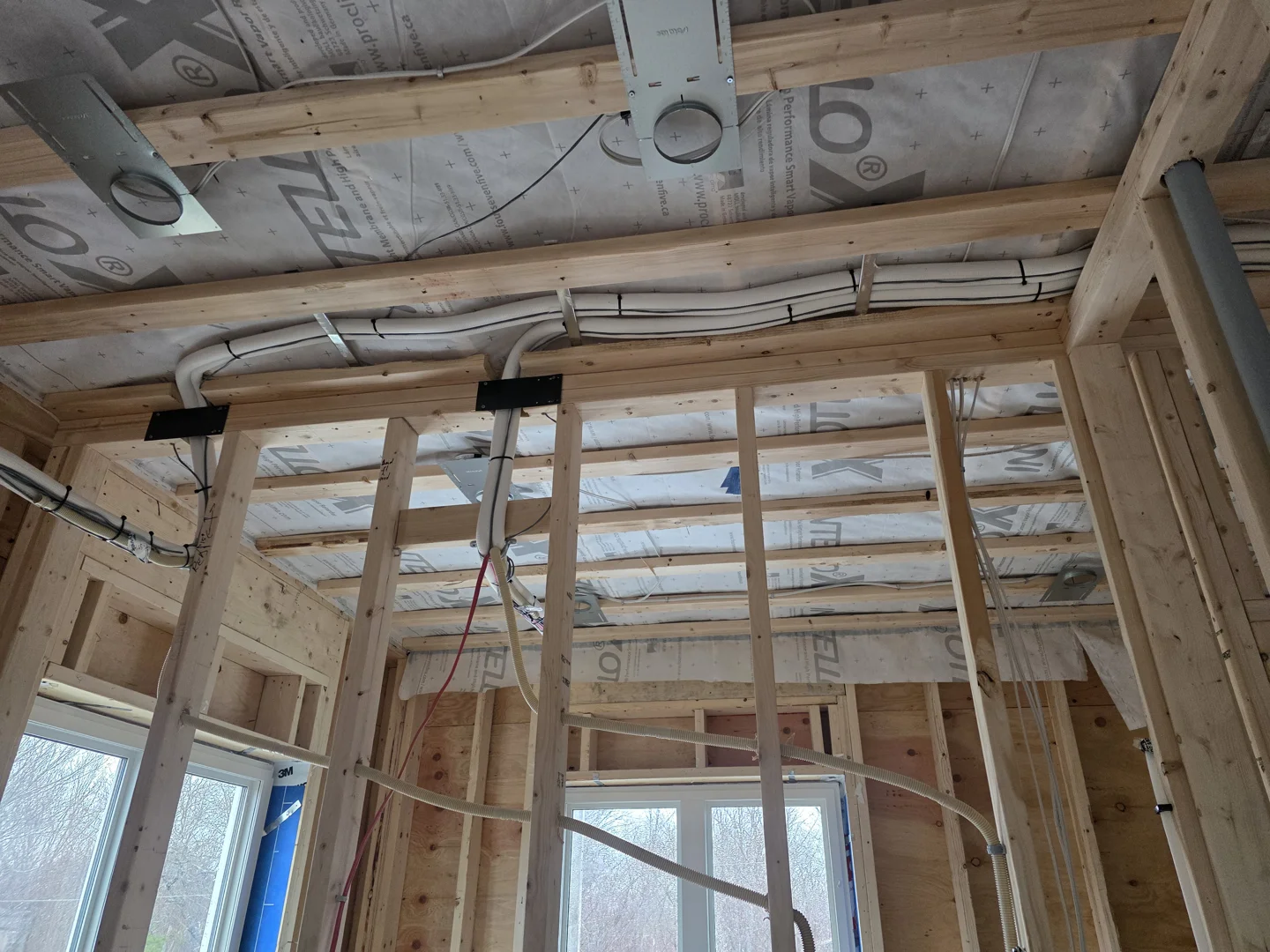
A successful new construction project relies on seamless coordination between different trades. The mechanical system, the electrical infrastructure, and the structural framing must all fit together inside the same walls and ceilings. If these systems are not carefully coordinated from the start, it leads to costly on-site clashes, delayed schedules, and compromised designs.
Learning how to coordinate electrical and HVAC installation in a new build in Nova Scotia is one of the best ways for builders and homeowners to ensure a smooth, stress-free construction process.
The mechanical and electrical systems are deeply interdependent. Modern high-efficiency ventilation systems, zoning dampers, and smart controls require dedicated electrical circuits, precise control wiring, and adequate space in the main electrical panel.
By coordinating our new construction electrical services in Nova Scotia with our mechanical design team, we ensure that:
In traditional construction, trades often worked in isolation, leading to "first-come, first-served" placement of pipes, ducts, and wires. This often resulted in a plumber running a drain line directly through the path of a major supply duct, forcing the mechanical crew to make sharp, unplanned bends that permanently restricted airflow.
To prevent these issues, we emphasize early planning and trade integration. Understanding how electrical planning for new construction differs from retrofit work in Atlantic Canada allows us to map out the exact pathways for every wire, pipe, and duct before framing even begins. This collaborative approach ensures that structural beams are not notched or drilled inappropriately, mechanical rooms are sized to allow easy future servicing, and the entire build stays on schedule and on budget.
To help you make the best decisions for your upcoming build, we have compiled a comparison of professional mechanical design versus standard rule-of-thumb practices:
| Feature / Metric | Professional Engineering Design (Manual J & D) | Standard Rule-of-Thumb Guesswork |
|---|---|---|
| Equipment Sizing | Exact match to building load calculations | Oversized based on generic square footage |
| Airflow Balance | Balanced CFM delivered to every room | Uneven airflow, hot/cold spots, drafts |
| System Lifespan | 15–25 years due to optimal, steady cycles | 10–12 years due to constant short-cycling |
| Humidity Control | Excellent (long run times pull moisture out) | Poor (shuts off before dehumidifying) |
| Duct Design | Engineered for low static pressure & low noise | Standard sizes, often restricted and noisy |
| Energy Efficiency | Maximizes equipment's rated efficiency | Degraded efficiency due to poor airflow |
| On-Site Clashes | Virtually eliminated through trade coordination | Frequent delays and costly field modifications |
The HVAC design process should begin during the initial blueprint phase, long before the foundation is poured. By involving a mechanical designer early, you can ensure that the home's architectural plans allocate adequate space for duct chases, mechanical rooms, and ventilation pathways. This early integration allows for a cleaner installation, maximizes usable living space, and prevents costly design changes down the road.
Every home has a unique layout, window placement, and orientation to the sun, which means every room has different heating and cooling requirements. A custom ductwork design ensures that the correct volume of conditioned air (measured in cubic feet per minute, or CFM) is delivered to each individual space. Custom fabrication also ensures that the duct system maintains the correct static pressure, which keeps the system running quietly and prevents the blower motor from overworking and failing prematurely.
In an airtight home, natural air infiltration is virtually non-existent, meaning airborne pollutants, moisture, and odors quickly build up to unhealthy levels. Mechanical ventilation systems, such as Heat Recovery Ventilators (HRVs), continuously exhaust this stale, polluted air from moisture-prone areas like bathrooms and kitchens. At the same time, they bring in fresh, filtered outdoor air to living areas and bedrooms, ensuring that the air you breathe is clean, healthy, and free of excess humidity.
Building a new home is a rare opportunity to shape your living environment from the ground up. While paint colors, fixtures, and countertops are easy to change down the road, the mechanical systems hidden behind your drywall are designed to last for decades. Getting the design right during the construction phase is the single most important factor in ensuring your home remains comfortable, healthy, and highly efficient for the long haul.
At Presidential Ventilation Systems Ltd., we bring over 30 years of experience in providing residential and commercial HVAC, electrical, and insulation services across Nova Scotia. As a leading Daikin Comfort Pro Dealer, we are dedicated to helping homeowners in Halifax, Dartmouth, Lower Sackville, Bedford, and surrounding communities build smarter, more comfortable homes.
Whether you are in the early planning stages of a new home or coordinating a complex light commercial build, our team is here to design and install custom ducted and ductless home comfort systems tailored to your exact needs. Reach out to us today to schedule a consultation and ensure your new build is set up for decades of worry-free comfort!